


Ever stopped mid-story because your imaginary nation needed a name, and nothing sounded right? You are not alone. A weak name can break the mood of a novel, a game, or even a school project, while a strong one makes readers believe the place truly exists. That is why we gathered more than 650 invented country names in one place. Each one is original, easy to say, and ready to use today, without any stress.
Whether you are building a fantasy kingdom, a sci-fi empire, a funny micronation, or a believable modern republic, there is something here for you. Every section explains the naming logic behind the names, so you learn why they work, not just what to copy. Scroll down, pick your favorites, mix and match the endings, and give your world an identity that people will remember long after they finish reading your amazing story, game or school project.
Why Fictional Country Names Matter More Than You Think
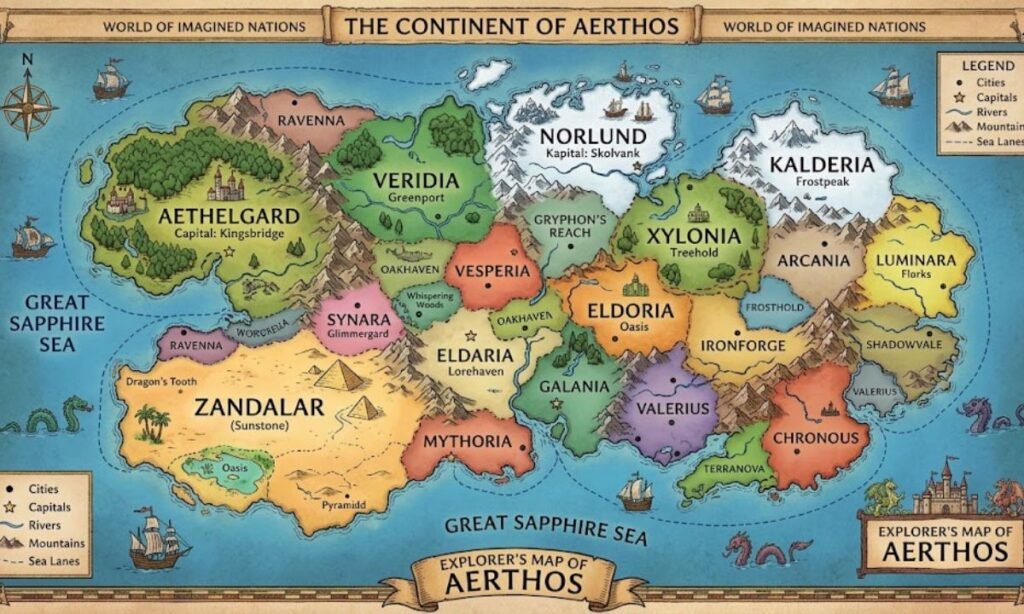
- A country name is the first thing a reader meets about your world. Before they learn anything about its politics or people, the name has already told them whether the place feels cold, warm, ancient, or futuristic.
- Good names carry hidden history. A name ending in “-mark” hints at borders and Nordic roots, while one ending in “-stan” suggests a land shaped by Persian influence. Readers feel this even if they cannot explain it.
- Believable names protect immersion. If a serious political thriller is set in “Fluffytown,” readers will laugh at the wrong moment. The name has to match the tone you want.
- Names are used constantly. Your characters will say them in dialogue, they will appear on maps, and players will see them on screen. A name that is hard to read or pronounce becomes tiring very quickly.
- A distinctive name also helps your project stand out. Search engines, readers, and game communities remember “Kryndor” far more easily than “Northland.”
What Makes a Fake Country Name Sound Real?
- Real names follow sound patterns. Most country names are built from a root word and an ending, so copying that two-part structure makes an invented name feel natural.
- Consistent endings create the feeling of a region. If your continent has three nations ending in “-via,” they will feel like neighbors, even without a map.
- Pronounceability matters. If you cannot say a name out loud in two seconds, your audience will stumble too. Two to four syllables is the comfortable range for most readers.
- Real names often come from geography. Rivers, mountains, coasts, and climates are common sources, so a name like “Fjellmark” feels rooted in a landscape.
- People and history also shape names. Many real countries are named after tribes, rulers, saints, or ancient empires, which gives your fictional nation an easy way to hint at a past.
- Avoid accidental clashes. A name that sounds almost identical to a real country, such as one letter away from a famous nation, can confuse readers and weaken your originality.
- Keep letters balanced. Too many rare letters, like Z, X, and Q in the same word, make a name look fake or silly unless that is your goal.
- Say it with a title. Test the name inside “Republic of ___” or “the people of ___.” If it still sounds natural, it is a strong choice.
Real Country Name Patterns to Study
- Kazakhstan shows the “-stan” pattern, which comes from a Persian word meaning “land of,” attached to a people’s name.
- Iceland is a plain descriptive name made from two English words. Simple compound names like this work well for northern or rural nations.
- Romania takes its name from a people, in this case a link to Rome. Naming a country after its founders is a pattern you can borrow.
- Luxembourg ends in “-burg,” which relates to a fortress or castle. It is a great model for mountainous or fortified lands.
- Indonesia blends the Greek words for “India” and “islands.” Combining two roots is one of the easiest ways to invent a name.
- Qatar is short and sharp, showing that two-syllable names can feel strong and modern.
- Kenya was named after a mountain, which proves that landmarks make excellent name sources.
- Algeria comes from the name of its capital city, a useful pattern when your story begins with one important city.
- Ecuador is simply the Spanish word for the equator. A name that describes a location can feel surprisingly real.
- Singapore comes from a Sanskrit phrase meaning “lion city.” It shows how an animal symbol can become a nation’s name.
- Costa Rica means “rich coast” in Spanish. Descriptive phrases that praise the land are common in older naming.
- San Marino honors a saint. Religious figures are a classic source for European-style names.
- Liechtenstein comes from a ruling family. If your story has a dynasty, a family-based name is believable.
- Papua New Guinea uses a “new” prefix borrowed from explorers’ comparisons. It is a handy pattern for colonial or settlement stories.
- Czechia is a modern short form of a longer name, a reminder that your fictional country can have a formal name and a casual nickname.
Fake Country Names That Sound Real
These names follow the root-plus-ending pattern, so they would not look out of place on a modern world map.
- Valdoria – a green, mountain-valley republic
- Marenthia – a sea-facing trade nation
- Corvania – a northern state with dark forests
- Tavaria – a sunny farming country
- Norvelle – a refined, cultured kingdom
- Belmora – a small, peaceful coastal republic
- Santoria – a warm, Spanish-flavored nation
- Kestonia – a modern, tech-forward state
- Lorvania – an old inland monarchy
- Dravenia – a stern, military-minded country
- Meridia – a southern land with long summers
- Altavia – a high-altitude mountain nation
- Zelmora – a spice-trading crossroads
- Brevonia – a tiny, wealthy banking state
- Calvaria – a hilly, wine-making country
- Sorenia – a quiet, northern democracy
- Rovenia – a river-based agricultural land
- Tessoria – a historic textile center
- Umbrelia – a rainy, misty island state
- Vestoria – a western border nation
- Halvoria – a rugged highland kingdom
- Karsonia – a mining-based industrial state
- Lunevia – a coastal country famous for moonlit festivals
- Mirandia – a harbor nation of merchants
- Novaria – a young country that split from an old empire
- Orsolia – a bear-themed forest nation
- Pelavia – a flat, windy plains republic
- Quintoria – a federation of five provinces
- Rostavia – a cold, steel-producing state
- Selvania – a jungle-covered tropical country
- Torvenia – a stormy cliffside realm
- Ulmeria – a quiet nation of old libraries
- Varnesia – an island chain with busy ports
- Westmarra – a sunset-facing western territory
- Xanderia – a bold, newly independent state
- Yarvonia – a lake-filled northern country
- Zandria – a desert-edge trading hub
- Arvelle – a chic, fashion-loving republic
- Brisonia – a windswept, grassy island
- Cantoria – a musical nation known for choirs
fake country names for stories
If you are writing fiction, the best names are the ones that hint at your plot without spelling it out. Think about whether your country is a friend, a threat, or a mystery. The names above fit most stories, and the section that follows gives you European-flavored options with a distinct regional feel.
- Pick a name that readers can remember after one mention, since side characters often speak of foreign nations only once or twice.
- Give your hero’s homeland a softer, rounder sound and the rival nation a harder, sharper one. Sound alone shapes how readers feel.
- Keep a short “name sheet” for your world. Writing each country with its capital, language, and adjective form (for example, “Valdorian”) saves you from inconsistent spelling later.
- Avoid starting every country name with the same letter, because readers will mix them up during busy scenes.
- Use the nickname trick. Characters often shorten long names, like calling “Brandovia” simply “the Brand,” which makes dialogue feel natural.
European-Sounding Fake Country Names
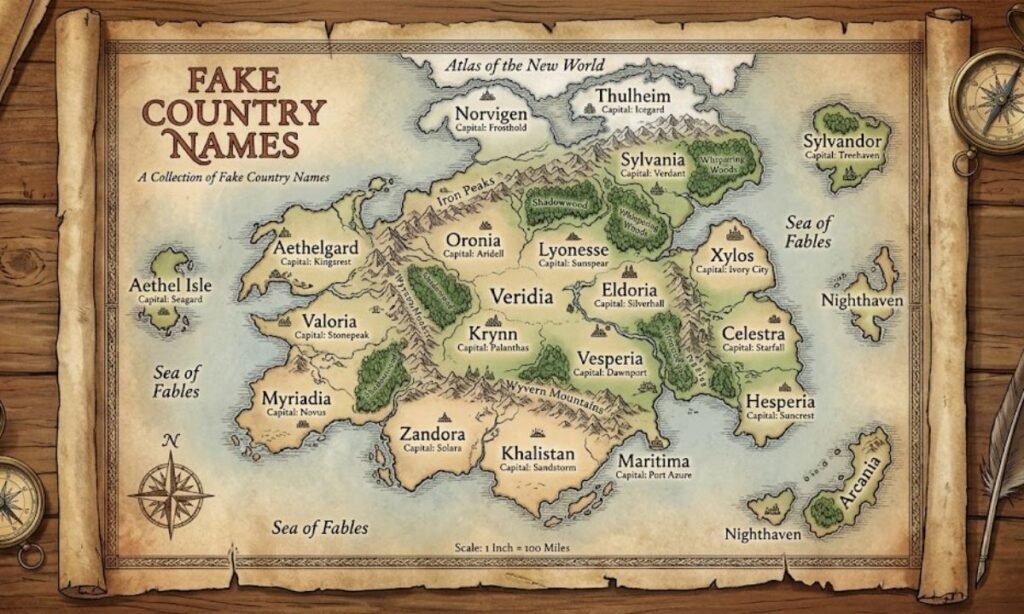
Here are names grouped by region of Europe, with the naming roots explained so you can copy the style.
- Vindmark – Nordic, “wind” plus “border land”
- Skaldheim – Nordic, a poets’ homeland
- Norrvik – Nordic, a northern bay
- Fjellmark – Nordic, a mountain frontier
- Solvik – Nordic, a sunny inlet
- Ulvaland – Nordic, “wolf land”
- Hjorvald – Nordic, a stag-ruled realm
- Istmark – Nordic, an icy borderland
- Brannvik – Nordic, a fire-lit coastal state
- Havnfjord – Nordic, a harbor fjord nation
- Altenburg – Germanic, an “old fortress” state
- Rheinhold – Germanic, a river-guarded country
- Drachenau – Germanic, a dragon meadow
- Waldmark – Germanic, a forest frontier
- Eisenfeld – Germanic, an “iron field” industrial land
- Hohenmark – Germanic, a high borderland
- Schwarzental – Germanic, a dark valley republic
- Grauwald – Germanic, a gray forest nation
- Ostenwald – Germanic, an eastern woodland
- Kronenfeld – Germanic, a crown-ruled plain
- Zlatovia – Slavic, a “golden” land
- Krasnovia – Slavic, a “beautiful” or red-toned land
- Dobrovia – Slavic, a kind, welcoming country
- Veliskia – Slavic, a “great” realm
- Morovia – Slavic, a seaside state
- Chernavia – Slavic, a dark, brooding land
- Stavoria – Slavic, a trade-route nation
- Podravia – Slavic, a lowland river country
- Kolovia – Slavic, a “wheel” or circular region
- Bystravia – Slavic, a fast-river state
- Montavelle – Romance, a mountain valley
- Castelmar – Romance, a castle by the sea
- Rivalonia – Romance, a river-rival nation
- Valmonte – Romance, a hill-valley state
- Portovela – Romance, a sailing harbor
- Lucenza – Romance, a “light” filled land
- Bellavista – Romance, a “beautiful view” republic
- Marvento – Romance, a sea-wind nation
- Orvalia – Romance, a golden-sunset country
- Casteluna – Romance, a moon castle realm
- Aldermoor – Celtic-British, an alder-tree moorland
- Glenhaven – Celtic-British, a safe glen
- Brackenmere – Celtic-British, a fern-covered lake
- Carrowmoor – Celtic-British, a rocky moor
- Dunmarrow – Celtic-British, a hill-fort state
- Ashfordshire – Celtic-British, an ash-tree county kingdom
- Eskerland – Celtic-British, a ridge-lined country
- Tarnholt – Celtic-British, a mountain-lake woodland
- Wexmoor – Celtic-British, a misty highland
- Pennaghy – Celtic-British, a hilltop kingdom
Cool country names That don T exist
Short, punchy names sound modern and bold, and they work well for thrillers, video games, and social media worldbuilding.
- Kryndor – edgy and industrial
- Axilon – clean and technical
- Zephyra – light and breezy
- Nexora – connected and futuristic
- Vireon – green and sharp
- Onyxar – dark and luxurious
- Pyralis – fiery and bright
- Quillon – elegant and blade-like
- Xylos – strange and ancient
- Yggora – mystical and forest-rooted
- Aurelion – golden and noble
- Bastion – a fortress-like country
- Cinderfall – a burned-and-rebuilt nation
- Duskhaven – a twilight safe harbor
- Echovale – a valley of sound
- Glacia – frozen and graceful
- Icarion – bold and sun-chasing
- Kaelith – mysterious and soft
- Nimbora – a cloud-covered kingdom
- Obsidara – volcanic and sleek
(Twenty more cool names are in the “Cool Made-Up Country Names” list further below.)
More European-Style Names
These are less common European flavors, including Alpine, Baltic, Mediterranean, and Balkan sounds.
- Edelmark – Alpine, a “noble” border region
- Gletschberg – Alpine, a glacier mountain
- Almhaven – Alpine, a high-pasture haven
- Bergtal – Alpine, a mountain valley
- Silberau – Alpine, a silver meadow
- Hochwald – Alpine, a high forest
- Tannenfeld – Alpine, a fir-tree plain
- Steinkrone – Alpine, a stone crown
- Edelweiss Reach – Alpine, a flower-named highland
- Felsenburg – Alpine, a rock fortress
- Baltavia – Baltic, a sea-edge state
- Taurinia – Baltic, a bull-symbol land
- Laimara – Baltic, a lucky country
- Rigovia – Baltic, a port city-state
- Jantara – Baltic, an amber-trading nation
- Dainova – Baltic, a song-loving republic
- Vaiskia – Baltic, a quiet lakeland
- Kuldavia – Baltic, a golden marshland
- Aistmark – Baltic, an ancient tribal land
- Meldara – Baltic, a honey-producing country
- Costaverde – Mediterranean, a green coast
- Isolmare – Mediterranean, an island sea
- Costaluz – Mediterranean, a coast of light
- Marisol – Mediterranean, a sea and sun republic
- Ventimare – Mediterranean, a windy sea
- Calamora – Mediterranean, a calm-bay nation
- Solaranto – Mediterranean, a sun-soaked port
- Portafina – Mediterranean, a refined harbor
- Sirenza – Mediterranean, a siren-legend coast
- Lavendria – Mediterranean, a lavender-field realm
- Karadova – Balkan, a black-water land
- Tesarna – Balkan, a rugged highland
- Montevar – Balkan, a mountain frontier
- Brdska – Balkan, a hill country
- Zorvia – Balkan, a dawn-facing state
- Drinovar – Balkan, a river-gorge nation
- Kotarska – Balkan, a coastal bay republic
- Velebitia – Balkan, a limestone mountain realm
- Sutjeska Reach – Balkan, a hidden canyon territory
- Prekara – Balkan, a crossing-point nation
Fake country names in movies
Filmmakers usually invent nations to avoid offending real governments, and they choose names that audiences accept in seconds. If you are writing a script, borrow that rule: make the name clear on first hearing and distinct from real places. A name that looks good in a subtitle but is hard to say aloud will cause trouble with actors. The famous examples appear later in this guide, and the list below shows how that style looks in original form.
- Keep it to three syllables or fewer for spoken lines.
- Give the nation a recognizable visual identity, such as a flag color or landmark, so viewers connect the name to a place.
- Use a “dictator-friendly” or “royalty-friendly” tone depending on the plot. Names ending in “-ia” feel regal, and names ending in “-stan” feel regional and gritty.
African & Middle Eastern-Sounding Fake Country Names
These names are invented and inspired by sound patterns from regional languages. They do not refer to any real country or community.
- Ouagara – West African-style, a savanna trading state
- Kourtania – West African-style, a river nation
- Benisar – West African-style, a coastal republic
- Tamboura – West African-style, a drum-culture kingdom
- Niambra – West African-style, a green delta
- Gorandi – West African-style, a highland country
- Zindara – West African-style, a gold-mining state
- Akoura – West African-style, a forest kingdom
- Lomberi – West African-style, a lagoon port
- Mbaridi – West African-style, a market-town nation
- Kilimara – East and Southern African-style, a mountain land
- Nyandaro – East and Southern African-style, a lake kingdom
- Zambera – East and Southern African-style, a river-valley nation
- Tanaru – East and Southern African-style, a coast and spice state
- Kijani – East and Southern African-style, a “green” republic
- Msimbo – East and Southern African-style, a code-and-trade hub
- Uhuria – East and Southern African-style, a freedom-themed state
- Zimbura – East and Southern African-style, a stone-city kingdom
- Kalahara – East and Southern African-style, a dry plains nation
- Mapendo – East and Southern African-style, a “beloved” country
- Qasirah – Arabic-style, a “short” or close land
- Khalidar – Arabic-style, an “eternal” realm
- Namirah – Arabic-style, a leopard-named country
- Safiria – Arabic-style, a pure, clear-water nation
- Zahiran – Arabic-style, a blooming oasis
- Yasmara – Arabic-style, a jasmine-scented land
- Dhurana – Arabic-style, a sun-baked plateau
- Qamarat – Arabic-style, a moon-themed state
- Sultanzar – Arabic-style, a ruler’s golden realm
- Medinara – Arabic-style, a city-centered state
- Hamdara – Arabic-style, a praise-worthy republic
- Zayidia – Arabic-style, a prospering desert emirate
- Nadira – Arabic-style, a “rare” country
- Saharqa – Arabic-style, an eastern desert land
- Barakat – Arabic-style, a blessed nation
- Shahrazan – Persian-style, a storyteller’s kingdom
- Kuhistar – Persian-style, a mountain land
- Zarvand – Persian-style, a time-and-fate realm
- Parvastan – Persian-style, a winged land
- Sepandar – Persian-style, a holy-earth state
- Daryastan – Persian-style, a sea-facing country
- Gulbahar – Persian-style, a spring-flower republic
- Farsiyar – Persian-style, a high-plateau nation
- Anushiran – Persian-style, an immortal-soul empire
- Tirkhand – Persian-style, an arrow-themed borderland
- Rostamar – Persian-style, a hero-legend country
- Kavira – Persian-style, a poet-led state
- Shirazad – Persian-style, a wine-and-garden realm
- Alborzia – Persian-style, a mountain-range nation
- Mehrdara – Persian-style, a sun-and-kindness land
Asian-Sounding Fake Country Names
All names below are invented. They borrow sound patterns only and are not tied to any real nation.
- Seokran – East Asian-style, a stone-orchid kingdom
- Hanjiro – East Asian-style, a river-and-forest state
- Tamayura – East Asian-style, a jewel-wave island nation
- Minhara – East Asian-style, a peaceful plains republic
- Shirogane – East Asian-style, a “silver” empire
- Yunlan – East Asian-style, a cloud-orchid land
- Liangmei – East Asian-style, a plum-blossom kingdom
- Sakuraya – East Asian-style, a cherry-blossom state
- Taeryong – East Asian-style, a great-dragon nation
- Hakuryu – East Asian-style, a white-dragon realm
- Siamara – Southeast Asian-style, a golden-temple kingdom
- Kalimora – Southeast Asian-style, a volcano island country
- Luzvaya – Southeast Asian-style, a harbor archipelago
- Mekhara – Southeast Asian-style, a great-river delta
- Tanahdara – Southeast Asian-style, a “land and water” state
- Anggara – Southeast Asian-style, a rice-terrace nation
- Sumbaya – Southeast Asian-style, a spice-island republic
- Narawan – Southeast Asian-style, a jungle kingdom
- Pattara – Southeast Asian-style, a beach-trading state
- Indravar – Southeast Asian-style, a sky-god realm
- Jambudwip – South Asian-style, a river-blessed “great island” land
- Chandrapal – South Asian-style, a moon-guarded country
- Suryakot – South Asian-style, a sun fortress
- Kaveristan – South Asian-style, a river-delta nation
- Ganjara – South Asian-style, a sacred-water state
- Vindhyara – South Asian-style, a hill-and-forest kingdom
- Maurava – South Asian-style, a peacock-themed empire
- Himaldesh – South Asian-style, a snow-peak nation
- Sindhara – South Asian-style, an old river civilization
- Pushkara – South Asian-style, a lotus-lake republic
- Karakhan – Central Asian-style, a black-khan steppe state
- Altaistan – Central Asian-style, a golden-mountain land
- Tengriya – Central Asian-style, a sky-spirit realm
- Bozkura – Central Asian-style, a gray-wolf plain
- Oguzland – Central Asian-style, a tribal heartland
- Syrdaria – Central Asian-style, a river-basin nation
- Khazarna – Central Asian-style, a crossroads kingdom
- Turanova – Central Asian-style, a new horse-lord country
- Samarkhia – Central Asian-style, a Silk Road trading city
- Orkhonia – Central Asian-style, a valley of ancient stones
- Dzongkhar – Himalayan-style, a fortress-monastery state
- Druksar – Himalayan-style, a thunder-dragon land
- Lhundara – Himalayan-style, a wish-granting highland
- Gyalmara – Himalayan-style, a king-of-peaks realm
- Tsangpur – Himalayan-style, a high-river city
- Kailasar – Himalayan-style, a sacred-mountain country
- Maluhara – Pacific-style, a calm-lagoon island chain
- Tavuara – Pacific-style, a coral-reef state
- Moanara – Pacific-style, an ocean-centered nation
- Tahunara – Pacific-style, a navigator-priest kingdom
Latin American-Sounding Fake Country Names
These invented names echo Andean, Caribbean, Central American, and Southern Cone sounds. They are fictional and do not point to real places.
- Quillaro – Andean-style, a moon-and-mountain land
- Tupacara – Andean-style, a royal highland
- Inticoya – Andean-style, a sun-queen state
- Pachamara – Andean-style, an earth-mother nation
- Wayrana – Andean-style, a wind-swept plateau
- Kolquera – Andean-style, a silver-storehouse republic
- Sumaqia – Andean-style, a “beautiful” valley country
- Chaskara – Andean-style, a messenger-runner empire
- Illimara – Andean-style, a snow-peak realm
- Apumara – Andean-style, a mountain-spirit kingdom
- Costalegre – Caribbean-style, a “joyful coast”
- Isla Brava – Caribbean-style, a wild island state
- Caribela – Caribbean-style, a beautiful sea nation
- Palmarena – Caribbean-style, a palm-and-sand republic
- Bahiavera – Caribbean-style, a true-bay harbor
- Tortugara – Caribbean-style, a turtle-island territory
- Cayomar – Caribbean-style, a small-key sea state
- Solenara – Caribbean-style, a sunny trade-wind country
- Marisola – Caribbean-style, a sea-and-sun archipelago
- Ronderia – Caribbean-style, a rum-making island nation
- Zempoara – Central American-style, a many-waters land
- Xochimar – Central American-style, a flower-sea state
- Quetzalan – Central American-style, a green-feather kingdom
- Tecuara – Central American-style, a jaguar-lord country
- Huitzara – Central American-style, a hummingbird realm
- Nahuara – Central American-style, a language-rich republic
- Cuauhtara – Central American-style, an eagle-guarded land
- Ixchelia – Central American-style, a moon-goddess nation
- Tonalco – Central American-style, a warm-sun state
- Yaxkara – Central American-style, a green-jungle kingdom
- Pampalur – Southern Cone-style, a flat grassland country
- Patagara – Southern Cone-style, a windy southern tip
- Aconcara – Southern Cone-style, a high peak republic
- Fuegora – Southern Cone-style, a fire-and-ice land
- Guaranova – Southern Cone-style, a river-and-forest state
- Iguazara – Southern Cone-style, a waterfall nation
- Tupinara – Southern Cone-style, an Amazon-edge kingdom
- Jaguaria – Southern Cone-style, a big-cat jungle state
- Selvaverde – Southern Cone-style, a “green jungle” republic
- Platara – Southern Cone-style, a silver-river delta
Cool Made-Up Country Names
This list adds more punchy names to the earlier cool selection, with no repeats.
- Zephyra – a light, breezy island
- Drakmoor – a dragon-haunted moor
- Frostholm – a snowy island fortress
- Galvanor – an energy-powered state
- Ironveil – a mist-covered mining country
- Jadeport – a green-stone trading harbor
- Kestrelon – a falcon-flag nation
- Lumeria – a land of glowing lights
- Mistralia – a windy southern coast
- Silvershade – a moonlit forest kingdom
- Thornwick – a prickly, defensive republic
- Umbriel – a shadowy twilight realm
- Vanguardia – a forward-looking union
- Wraithmere – a ghostly lake country
- Zenithia – a high-peak empire
- Prismara – a rainbow-trading nation
- Obsidara – a black-glass volcanic land
- Stormhaven – a storm-sheltered port
- Tidewrath – a sea-battering coast
- Verdance – a lush, leafy republic
- Wildmere – an untamed lake region
- Nimbora – a cloud-layer nation
- Aurelion – a golden-age empire
- Cinderfall – a volcanic-ash country
- Echovale – a valley of repeating sounds
- Falconreach – a cliff-top eagle kingdom
- Kaelith – a quiet, mysterious land
- Vireon – a verdant, sharp-edged state
- Pyralis – a flame-lit territory
- Quillon – a refined, blade-themed republic
(Names such as “Zephyra” and “Vireon” appear in both lists as style references. Treat them as one entry when counting your total.)
Fake country names fantasy
Fantasy names work best when they feel old, tell a short story, and use soft, flowing sounds. They should also feel different from modern nations. The section below gives you ready-made fantasy realms, and you can reshape any of them by changing the ending to “-heim,” “-vale,” or “-reach.”
Fantasy Country Names
- Eldoria – an ancient elven forest realm
- Aetherion – a floating sky kingdom
- Dragonspire – a peak-top dragon territory
- Elvenmere – a lake home of elves
- Faerwyn – a glittering fairy court
- Gryphonia – a griffin-riding highland
- Hollowmere – a haunted marsh realm
- Illyndor – a silver-moon kingdom
- Jorundal – a giant-built mountain hall
- Kaldenhal – a cold stone citadel
- Lythenia – a silk-and-spell nation
- Mythralis – a land of lost legends
- Narathil – a starlit elven city
- Oakenreach – a tree-giant homeland
- Pendrathal – a ruined empire reborn
- Quellmoor – a storm-lashed wizard moor
- Runehollow – a carved-stone hidden valley
- Sylvaris – a living-forest nation
- Thaldoria – a dwarf-forged kingdom
- Umbravale – a valley of eternal dusk
- Valkyrion – a warrior-maiden realm
- Whisperwood – a talking-tree forest state
- Xanthoria – a golden-yellow desert empire
- Yvarith – a hidden mist kingdom
- Zarathane – a sorcerer-king domain
- Arcanum – a magic-academy country
- Balefire – a land of cursed flames
- Crystalmere – a gem-lake kingdom
- Dawnspire – a sunrise tower realm
- Everfrost – a never-melting northern land
- Fablewood – a story-filled forest
- Glimmerfen – a glowing swamp nation
- Heartstone – a stone-hearted mountain realm
- Ivoryhold – a bone-white fortress state
- Jadeclaw – a green-dragon territory
- Emberhold – a forge-city kingdom
- Moonwhisper – a night-blooming realm
- Nightbloom – a flower-of-darkness nation
- Starlingham – a bird-flocking kingdom
- Wyrmrest – a sleeping-wyrm domain
- Tolvareth – a twelve-tower realm
- Brightmantle – a sun-cloaked monarchy
- Cindervale – a post-fire rebuilding land
- Draelhorn – a horn-blowing mountain clan realm
- Elowen Reach – an elm-tree border land
- Frostmantle – an ice-armored kingdom
- Goldenvale – a rich farming dale
- Highthrone – a cliff-top throne realm
- Ironbloom – a metal-garden kingdom
- Sunderfall – a broken-world remnant
Unique & Creative Fake Country Names
Creative names often come from objects, foods, plants, and everyday items. They suit children’s stories, cartoons, and cozy fantasies.
- Quillbury – a feather-pen scholars’ republic
- Bubblemar – a soap-bubble seaside kingdom
- Cobaltia – a deep-blue mining nation
- Marzipania – a sweet, candy-making land
- Nimbusland – a cloud-pillow country
- Origamia – a paper-folding empire
- Pebbleton – a stone-skipping lake state
- Quasarland – a star-struck observatory nation
- Saffronia – a spice-gold kingdom
- Tangerinia – a citrus-grove republic
- Vellumia – a parchment-and-ink nation
- Whimsyland – a playful, odd country
- Xylophia – a musical wooden-bar state
- Yarnshire – a knitting county kingdom
- Zigzagia – a twisting-road republic
- Almondia – a nut-grove nation
- Buttonia – a sewing-guild state
- Clockhaven – a timekeepers’ town-nation
- Dandelia – a wish-seed meadow
- Emberlynn – a warm-glow lantern land
- Fernwick – a mossy, green kingdom
- Glowmere – a firefly lake country
- Honeymere – a bee-farm lakeland
- Inkwell Isles – a writers’ archipelago
- Jasminia – a fragrant garden nation
- Kettleby – a tea-loving republic
- Lanternia – a lamplit festival state
- Mosaica – a tile-art kingdom
- Nutmegia – a baking-spice empire
- Opalia – a rainbow-stone state
- Papyria – an ancient-scroll nation
- Quartzia – a clear-crystal country
- Riddlemoor – a puzzle-loving moor
- Sundaria – a sundial-guided realm
- Tulipara – a flower-bulb republic
- Umberland – an earth-toned farming country
- Violetta – a purple-hued coast
- Willowmere – a drooping-tree lake kingdom
- Yuzuland – a citrus-orchard island
- Zinnia – a bright-flower highland
Fictional Country Names That Sound Real
These use full formal titles, the way a real government might write them on a passport or treaty. The title type also tells readers how the country is ruled.
- Republic of Ostavia – a standard presidential republic
- Kingdom of Merovia – a traditional monarchy
- Federal Republic of Brandovia – a union of states
- Grand Duchy of Lorrenia – a tiny, wealthy duchy
- Principality of Aldenmar – a prince-led microstate
- Commonwealth of Tervania – a cooperative island nation
- Sultanate of Qaravar – a desert sultan’s domain
- Democratic Republic of Kasembo – a post-revolution African-style state
- Empire of Valtoria – an expanding imperial power
- People’s Republic of Dunmeria – a one-party state
- Emirate of Zahrawan – a trade-rich emirate
- Union of Pellegria – a merged-states country
- Confederation of Norland – a loose northern alliance
- Free State of Havenmark – an independent harbor state
- Duchy of Calderra – a duke-ruled volcanic land
- Khanate of Torgoun – a steppe-horse khanate
- Republic of Istravia – a lakeside republic
- Kingdom of Elderon – an old, tradition-heavy kingdom
- Federation of Kandara – a multi-region federation
- Sovereign State of Ruvenia – a small independent state
- Grand Republic of Santaluna – a moon-themed republic
- Dominion of Westerley – a former-colony dominion
- Republic of Aurantia – an orange-grove economy
- Kingdom of Basileon – a Greek-flavored monarchy
- Principality of Montelara – a hilltop principality
- Federal Union of Zorvakia – a divided-then-united union
- Republic of Lakemoor – a lake-district republic
- Imperial State of Hesperon – a western imperial nation
- Democratic Republic of Amaruni – a river-basin democracy
- Kingdom of Soravia – a sky-themed highland kingdom
Sci-Fi & Futuristic Nation Names
Sci-fi names often replace land with ideas like planets, stations, and alliances, so many of these end in “Union,” “Accord,” or “Compact.”
- Nova Helios – a sun-powered colony
- Orbis Prime – a main-world capital
- Vexar Colony – a frontier mining settlement
- Helion Union – a solar-energy alliance
- Quantara – a quantum-computing state
- Zeta Concord – a multi-planet agreement
- Astraeon – a star-born empire
- Cygnus Reach – a swan-constellation frontier
- Titanis – a Saturn-moon nation
- Andromar – a galaxy-spanning kingdom
- Kepleria – an exoplanet-discoverer republic
- Lunaris Republic – a moon-based democracy
- Marsara – a red-planet settlement
- Nebulara – a gas-cloud station nation
- Orionis Pact – a hunter-constellation treaty
- Polaris Dominion – a navigation-guild empire
- Stellarion – a starship-fleet state
- Terraform League – a world-building alliance
- Ceres Free State – an asteroid-belt independent state
- Europa Syndicate – an ice-moon trade group
- Proxima Federation – a nearest-star federation
- Aldebara – a red-giant empire
- Exodus Reach – a refugee-fleet territory
- Vega Collective – a shared-resources community
- Hyperia Accord – a fast-travel treaty bloc
- Sirian Compact – a dog-star alliance
- Quasar Republic – a bright-core republic
- Pulsaria – a rhythm-of-stars nation
- Singularia – an AI-governed state
- Neutronia – a dense-matter mining state
- Photonia – a light-based economy
- Cryonia – a cold-sleep colony
- Ionara – a charged-particle nation
- Gravitas Union – a gravity-tech federation
- Axiom Republic – a logic-driven government
- Zenara Prime – a peaceful capital world
- Nexus Alliance – a network of space cities
- Chronara – a time-research state
- Deltavar – a speed-and-thrust colony
- Epsilon Dominion – an outer-rim empire
Steampunk-Themed Fictional Nation Names
Steampunk names borrow from brass, gears, airships, and Victorian industry. Use heavy, clanking syllables to give them weight.
- Brassport – a polished-metal harbor
- Cogsworth Republic – a clockwork democracy
- Gearhaven – a gear-makers’ refuge
- Ironclad Isles – a battleship island chain
- Copperton Union – a copper-wire alliance
- Clockspire – a tower-clock capital
- Steamgate – a vapor-powered border city
- Aetherwick – an airship-fuel state
- Pistonia – an engine-driven nation
- Gaslight Reach – a lamp-lit industrial region
- Boilerhaven – a furnace-city refuge
- Cogmere – a lake of spinning wheels
- Valvewick – a pipe-network country
- Riveton – a rivet-built fortress state
- Smokestack Dominion – a factory-chimney empire
- Brasshollow – a metal-mining valley
- Clanksworth – a noisy workshop kingdom
- Tinkerton – an inventors’ republic
- Pressurea – a pressure-chamber nation
- Flywheel Kingdom – a spinning-power monarchy
- Dirigibia – a floating-balloon nation
- Sprocketville – a gear-tooth town-state
- Whistlemoor – a steam-whistle moorland
- Lampwick Republic – an oil-lamp democracy
- Chimneyshire – a smoke-filled shire kingdom
Dark & Sinister Fictional Country Names
Dark names use heavy consonants and words about decay, grief, and shadows. These are perfect for villain nations or horror settings.
- Morgrave – a land of the dead
- Nethermoor – a low, cursed marsh
- Blightfall – a poisoned-harvest state
- Dreadmarch – a war-footed borderland
- Ashenveil – a burned-sky realm
- Grimholt – a grim wooded hold
- Hexmoor – a witch-haunted moorland
- Ruinvale – a collapsed civilization
- Gloomreach – a never-sunlit kingdom
- Cryptmarch – a tomb-lined road nation
- Bonecrown – a skeleton king’s domain
- Wraithfall – a ghost-battle plain
- Shadowmire – a dark swamp state
- Scourgehold – a punishment-fortress land
- Plaguemoor – a sickness-ridden moor
- Ravencroft – a crow-filled estate nation
- Sablemourn – a black-mourning kingdom
- Carrionis – a scavenger-ruled land
- Doomspire – a tower of ruin
- Ebonreach – a black-stone frontier
- Hollowgrave – an empty burial country
- Ironshroud – a metal-covered despot state
- Nightmarrow – a bone-deep dark realm
- Obliveon – a land of forgetting
- Pestilara – a plague-dominated province
- Thornweep – a bleeding-thorn kingdom
- Vilemark – a corrupt border zone
- Wailing Reach – a land of echoing cries
- Tyrannia – a tyrant’s heartland
- Sorrowmere – a lake of grief
Funny Fake Country Names
Funny names rely on silly sounds, food words, and exaggerated endings. They are great for comedy, parody, and party games.
- Snortland – a pig-snorting republic
- Giggleton – a laugh-filled state
- Burpistan – a fizzy-drink nation
- Wobblia – a jelly-shaking kingdom
- Noodleland – a spaghetti-based economy
- Pickleburg – a jar-making city-state
- Flopovia – a pancake-flipping country
- Sneezonia – a pollen-heavy land
- Bumblebia – a bumbling bee nation
- Doodlestan – a scribble-drawing republic
- Pancakistan – a breakfast-lovers’ union
- Sockovia – a lost-sock sanctuary
- Wafflestan – a syrup-rich land
- Yodelburg – a mountain-yodeling state
- Zonkistan – a sleepy, napping nation
- Grumblemoor – a complaining-people moor
- Hiccupia – a hiccup-prone island
- Jellybeanistan – a candy-colored country
- Kazoovia – a kazoo-orchestra nation
- Llamaland – a llama-run republic
- Muffinstan – a bakery-ruled nation
- Oopsylvania – a country of happy accidents
- Pogostan – a bouncy, springy state
- Quackistan – a duck-dominated land
- Rubberduckia – a bathtub-kingdom
- Soupovia – a ladle-loving nation
- Tickleton – a ticklish capital
- Underpantsia – a wardrobe-malfunction republic
- Waddleburg – a penguin-walking city-state
- Yawnistan – a sleepy, quiet country
Fake Country Names for School Projects
These are geography-friendly names. Each one points to a clear landform or climate, which makes mapping and writing a country report much easier.
- Westoria – a western coastal plain
- Eastmarch – an eastern border region
- Northhaven – a cold, northern harbor
- Southvale – a warm southern valley
- Riverland – a country built along a great river
- Mountainia – a high-altitude nation
- Coastara – a long shoreline state
- Forestia – a heavily wooded country
- Plainsmark – a wide, flat farming nation
- Lakeshire – a lake-district kingdom
- Valleria – a fertile valley republic
- Tundralia – a frozen, treeless nation
- Savannara – a grassland and wildlife country
- Deltaria – a river-mouth delta state
- Archipelia – a nation made of many islands
Best Fake Country Names for School Projects
These suit social studies, Model UN, and class debates. Each name carries a value or theme that you can build a government around.
- Peninsara – a nation on a narrow peninsula
- Canyonia – a deep-gorge state
- Glacieria – an ice-capped land
- Oasisland – a desert-oasis nation
- Unitaria – a country built on unity
- Peacemoor – a neutral, peace-keeping state
- Harmonia – a balanced multicultural republic
- Libertia – a freedom-loving democracy
- Equalia – a fairness-based society
- Solidara – a worker-cooperation nation
- Justiana – a court-and-law republic
- Verdantia – an eco-friendly green nation
- Sunnyshore – a tourism-focused coast
- Triadia – a three-province federation
- Learnovia – an education-first state
Famous Fictional Countries in Pop Culture
- Fictional nations often shape how we imagine the real world. They are used to explore politics, technology, and culture without pointing at an actual government.
- Some became so popular that fans treat them as real places, creating maps, flags, and travel guides for them.
- They are all owned by their creators, so use them for inspiration and reference only. Do not use these names for your own published work.
- The next two sections split them by format so you can see how each medium builds its nations.
- Study how each name hints at culture. A single word like “Wakanda” suggests a whole society, which is the effect you want from your own invention.
Famous Fictional Countries in Literature & Film
- Wakanda – a hidden, high-tech African nation in Marvel stories
- Genovia – a small European principality in The Princess Diaries
- Latveria – the home of Doctor Doom in Marvel Comics
- Narnia – a magical land in C. S. Lewis’s novels
- Ruritania – a fictional kingdom from a famous adventure novel, now a term for such settings
- Freedonia – a mock-nation in the comedy film Duck Soup
- Zubrowka – the alpine republic in The Grand Budapest Hotel
- Elbonia – a muddy, ridiculous nation in the Dilbert comic strip
- Sokovia – an Eastern European-style country in Marvel films
- Zamunda – a rich African kingdom in Coming to America
- Wadiya – the dictator-led nation in the comedy The Dictator
- Borduria – the rival state in the Tintin comics
- Syldavia – the Balkan-style kingdom in Tintin
- Panem – the divided nation in The Hunger Games
- Gilead – the totalitarian state in The Handmaid’s Tale
- Oceania – a superstate in George Orwell’s 1984
- Lilliput – the island of tiny people in Gulliver’s Travels
- Brobdingnag – the land of giants in Gulliver’s Travels
- Laputa – a floating island in Gulliver’s Travels
- Erewhon – a utopian-satire land in Samuel Butler’s novel
- Graustark – a small kingdom in a popular early-1900s novel
- Utopia – the ideal island in Thomas More’s book
- Florin – one of two rival lands in The Princess Bride
- Guilder – the other rival land in The Princess Bride
- Markovia – a DC Comics Eastern European-style nation
- Krakozhia – the fictional country in the film The Terminal
- Aldovia – the royal kingdom in the A Christmas Prince films
- Grand Fenwick – the tiny duchy in The Mouse That Roared
- Gondor – a kingdom in Tolkien’s Middle-earth
- Rohan – the horse-lord realm in Tolkien’s Middle-earth
Famous Fictional Countries in TV
- Westeros – the continent of the Seven Kingdoms in Game of Thrones
- Dorne – the sun-baked southern region in Game of Thrones
- The Reach – the fertile garden region in Game of Thrones
- The Vale – the mountain-protected region in Game of Thrones
- The Iron Islands – the seafaring, rocky territory in Game of Thrones
- Valyria – the fallen dragonlord empire in Game of Thrones
- Braavos – the canal city-state in Game of Thrones
- Fire Nation – the aggressor nation in Avatar: The Last Airbender
- Earth Kingdom – the largest nation in Avatar: The Last Airbender
- Air Nomads – the monastery-based people in Avatar: The Last Airbender
- Southern Water Tribe – an icy homeland in Avatar: The Last Airbender
- Northern Water Tribe – a fortified polar city in Avatar: The Last Airbender
- Land of Ooo – the setting of Adventure Time
- Candy Kingdom – a sweet realm in Adventure Time
- Equestria – the pony land in My Little Pony
- Pottsylvania – the spy-filled nation in Rocky and Bullwinkle
- Qumar – a fictional Middle Eastern-style state seen in The West Wing and Homeland
- Gallifrey – the Time Lords’ home in Doctor Who
- Skaro – the Daleks’ home in Doctor Who
- Corona – the kingdom in Tangled: The Series
- Bajor – the planet-nation in Star Trek: Deep Space Nine
- Cardassia – the military power in Star Trek
- Klingon Empire – the warrior civilization in Star Trek
- Romulan Star Empire – the secretive rivals in Star Trek
- Vulcan – the logic-based society in Star Trek
Alternate History Country Names
Alternate history asks “what if?” These names imagine nations that could have existed if events had gone differently.
- Neo Carthage – what if Carthage had survived
- Novaroma – a Rome that never fell
- Vinlandia – a lasting Norse settlement in North America
- Aztlanor – an Aztec state that resisted conquest
- Byzantora – a Byzantine empire that endured into modern times
- Tahuantara – an Inca state that stayed independent
- Lusitara – a stronger Portuguese-style world power
- Neuprussia – a Prussia that never merged into a larger country
- Habsburgia – a multi-ethnic empire that reformed instead of collapsing
- Ottomara – an Ottoman state that modernized early
- Mughalara – a Mughal-style empire that held on
- Nubaria – a Nubian kingdom that stayed a major power
- Manseria – a West African trading empire that grew into a modern state
- Norbritannia – a Britain shaped by a different invasion history
- Nieuwlandt – a Dutch settlement that was never handed over
- Alaskovia – a northern colony that stayed with its first founders
- Kamehara – a Pacific kingdom that avoided annexation
- Colonia Unita – colonies that formed a different union
- Lone Starland – a republic that stayed independent
- Silesara – a borderland that became its own nation
Mythology-Inspired Fake Country Names
These names borrow sounds and themes from myths without copying any actual place. Use them to give your world a layer of ancient meaning.
- Valhalmark – Norse-inspired, a hall-of-heroes frontier
- Olympara – Greek-inspired, a mountain-gods kingdom
- Elysara – Greek-inspired, a blessed-afterlife land
- Tartarion – Greek-inspired, a deep-prison realm
- Midgarda – Norse-inspired, a middle-world nation
- Yggdrasia – Norse-inspired, a world-tree state
- Aesirholm – Norse-inspired, a god-clan island
- Vanirmere – Norse-inspired, a fertile lake of old gods
- Hesperidia – Greek-inspired, a golden-apple garden
- Arcadara – Greek-inspired, a pastoral paradise
- Avalonne – Celtic-inspired, a misty island of healing
- Hyperboria – Greek-inspired, a land beyond the north wind
- Anubara – Egyptian-inspired, a jackal-guarded necropolis state
- Ramesara – Egyptian-inspired, a pharaoh’s golden empire
- Osirian – Egyptian-inspired, a death-and-rebirth kingdom
- Isiara – Egyptian-inspired, a magic-and-motherhood nation
- Thothmar – Egyptian-inspired, a scribes’ wisdom state
- Bastetia – Egyptian-inspired, a cat-goddess land
- Odinsvik – Norse-inspired, a one-eyed-god bay
- Freyaland – Norse-inspired, a love-and-fertility realm
- Lokimoor – Norse-inspired, a trickster’s marsh
- Perunia – Slavic-inspired, a thunder-god country
- Veleshar – Slavic-inspired, an underworld-herd kingdom
- Mokoshia – Slavic-inspired, an earth-mother land
- Cernunnia – Celtic-inspired, a horned-god forest
- Tuathara – Celtic-inspired, a tribe-of-the-gods state
- Brighidale – Celtic-inspired, a flame-and-poetry valley
- Manannara – Celtic-inspired, a sea-god island
- Amaterasia – Japanese-inspired, a sun-goddess empire
- Kukulkara – Mesoamerican-inspired, a feathered-serpent state
How to Create Your Own Fake Country Name
Making your own name is easier than it seems. Use this simple formula: root + connector + ending. Then test it out loud.
- Start with a root from a landscape word, such as “mar” (sea), “mont” (mountain), or “val” (valley). This keeps the name tied to geography.
- Add a short connector like “-o-” or “-a-” to make it flow. “Mar” plus “o” becomes “Maro.”
- Finish with an ending that matches the region: “-via” or “-ia” for Europe, “-stan” for Central Asia, “-land” for the north, and “-ar” for desert states.
- Example 1: “Mar” + “o” + “via” = Marovia, a sea-facing European nation.
- Example 2: “Kuh” + “i” + “stan” = Kuhistan, a mountain land in a Persian style.
- Example 3: “Sol” + “a” + “land” = Soland, a sunny northern island.
- Example 4: “Terra” + “n” + “ova” = Terranova, a new-earth colony, perfect for sci-fi.
- Example 5: “Iron” + “hold” = Ironhold, a dwarf-style fantasy fortress.
- Example 6: Reverse a word, like “Nomad” into Damon, then add “-ia” for Damonia. Reversal is an easy trick for names that feel unfamiliar yet natural.
- Example 7: Mix two words, like “silver” and “forest,” to get Silvest, a quick fantasy blend.
- Example 8: Swap one letter in an old word, such as changing “Aurora” to Aurova, so the name feels new but familiar.
- Example 9: Add a historical title, like “Grand Duchy of,” to a basic name to make it feel official.
- Example 10: Say the name with an accent, such as in a news announcer’s voice. If it still sounds smooth, keep it.
- Before you commit, search the name online. If a real place, company, or popular game already uses it, adjust one or two letters to stay unique.
Frequently Asked Questions
Can I use these fake country names in a published book or game?
Yes, you can use the original invented names in this guide for your own creative work, since simple names usually cannot be copyrighted. However, trademarks can still apply to names used for products or businesses, so check before using one on merchandise. The famous fictional names in the pop culture sections belong to their creators and should be used for reference only. I am not a lawyer, so for commercial projects, consider getting professional advice.
How do I make sure a name is not already a real place?
Search the name in a web browser, a map service, and a trademark database. Also try variations in spelling, since a name that is one letter away from a real place can still confuse readers. If you find a clash, change a syllable or swap the ending.
How many syllables should a country name have?
Two to four syllables work best for most readers. Shorter names feel strong and modern, while longer ones feel formal or ancient. If a name is longer than four syllables, give your characters a natural nickname for everyday speech.
What is the difference between a country name and a nation name?
A country name usually points to a territory with borders, such as “Valdoria.” A nation name usually describes a people or culture, such as “the Valdorian people.” Using both in your world helps readers understand who lives where.
How can I make a name feel older or more historical?
Use older sound patterns, such as double consonants, soft endings like “-ene” or “-ium,” and roots that suggest rivers, mountains, or ancient peoples. Giving the name a story also helps. For instance, mention that it comes from a vanished tribe or a long-forgotten king.
Should every country in my world follow the same naming style?
No. A few shared patterns make a region feel connected, but a whole world with identical endings looks lazy. Mix at least three or four different styles, and let neighboring countries share some sounds while distant ones feel completely different.
Conclusion
Choosing a name for your invented country is one of the first creative decisions that shapes how people experience your world, and now you have more than 650 options to start from. You have seen how real names are built, why some sound believable while others feel playful or dark, and how to mix roots and endings to create your own. The best advice is simple. Say the name aloud, test it inside a sentence, and make sure it matches the mood of your story. Pick a favorite, adjust it until it feels right, and let your world begin.