


Have you ever read a story where the villain’s name sent a chill down your spine before he even spoke? That is the power of a well-chosen name. A single word can promise danger, mystery, or quiet cruelty. Whether you are writing a novel, building a game world, or just naming a pet with attitude, the right dark name does half the work for you. This guide gives you over 850 of them, sorted and explained.
Here is the best part: you do not need to be a language expert to pick well. Every list below comes with context, such as real meanings, origins, or the mood a name creates, so you can choose with confidence. Some names come from myth, history, and religion, while others are original creations built for fantasy and fiction. Read on, mark your favorites, and find the name that makes your villain unforgettable.
What Are Evil Names?
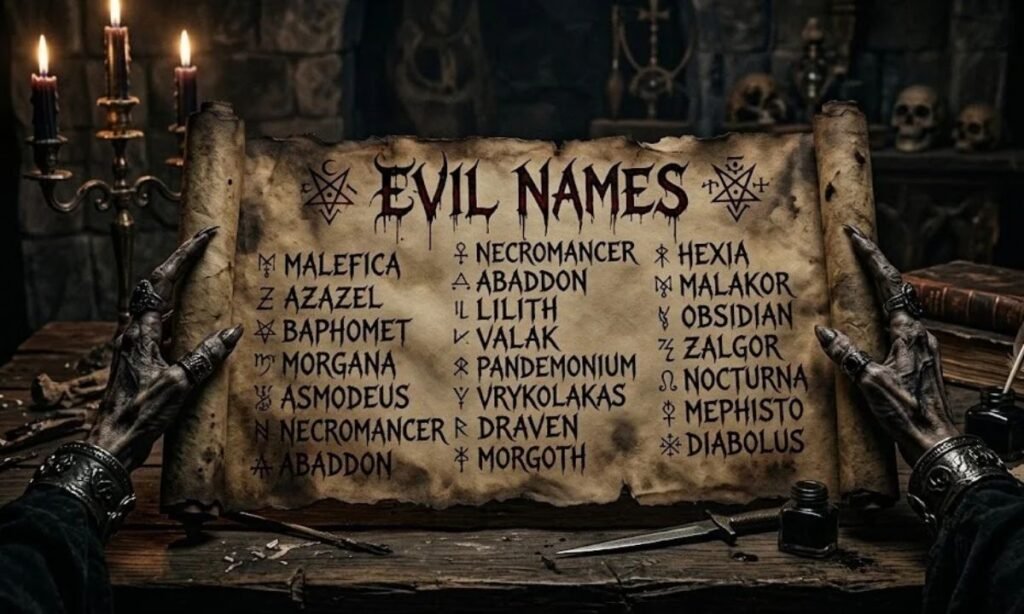
- An evil name is any name that makes a listener expect menace, cruelty, or darkness before they know anything about the person.
- Some carry a dark meaning in their roots, like “bitter,” “death,” or “destroyer.”
- Others earn their reputation from history or fiction, such as Nero, Judas, or Jezebel.
- A third group is simply built to sound sinister, using harsh sounds and heavy rhythm.
- No name is evil by nature. Context, culture, and story create the feeling.
- Many “evil” names are ordinary names in their home language, so check the meaning before you use one for a real child.
What Makes a Name Sound Evil? The Phonosemantics of Darkness
- Phonosemantics is the study of how sounds carry emotional meaning, and it explains why some names feel dangerous.
- Hard stops like K, G, T, and D feel sharp and aggressive. Think of Kragnar or Dredmoor.
- Low, round vowels like O and U feel heavy and ominous, which is why “Gorath” sounds darker than “Evie.”
- Hissing sounds like S, Z, and X suggest snakes and whispers, which is why Zarvok and Nyxara work so well.
- Long, slow names feel patient and calculating, while short, blunt names feel brutal.
- Writers often confirm this by reading names aloud. If the mouth feels like it is biting, the name usually reads as threatening.
Antagonist Names for Dark & Memorable Characters
- A good antagonist name is easy to remember, hard to forget, and fits the character’s personality.
- These 25 names suit novels, short stories, and screenplays.
- Malachar
- Vorthak
- Seraphine Crowe
- Mordrake
- Kaelith
- Zarvok
- Nyxara
- Thorne Ashgrave
- Grimshaw
- Valdrek
- Morgrath
- Sylvanna Noir
- Dredmoor
- Ixara
- Balthazar Vane
- Corvane
- Hexley
- Lucan Draith
- Morwenna Slate
- Tyberon
- Skarn
- Veyra
- Ozmund
- Dravik
- Eldrith
The Anatomy of a Great Villain Name
- Sound: pick consonants and vowels that match the villain’s nature, either sharp and fast or slow and heavy.
- Length: two or three syllables are the sweet spot, since they are easy to say and still feel weighty.
- Contrast: a soft, elegant name on a cruel character, like Seraphine, can unsettle readers more than a growl of a name.
- Meaning: a hidden meaning in the roots rewards curious readers and adds depth.
- Distinctiveness: avoid names too close to famous villains, because readers will compare them right away.
- Pronounceability: if readers cannot say it in their heads, they will stumble and lose the mood.
Best Evil Names
- These 30 names mix classic, elegant, and quietly threatening options for both genders.
- Damien
- Cassius
- Lucian
- Magnus
- Silas
- Draven
- Mortimer
- Octavian
- Malcolm
- Ambrose
- Thaddeus
- Sebastian
- Alaric
- Maximilian
- Cornelius
- Lysander
- Morgana
- Ravenna
- Selene
- Scarlett
- Raven
- Vesper
- Lenore
- Marcella
- Delphine
- Octavia
- Valentina
- Cordelia
- Ottoline
- Rosalind
Best Evil Names with Meanings
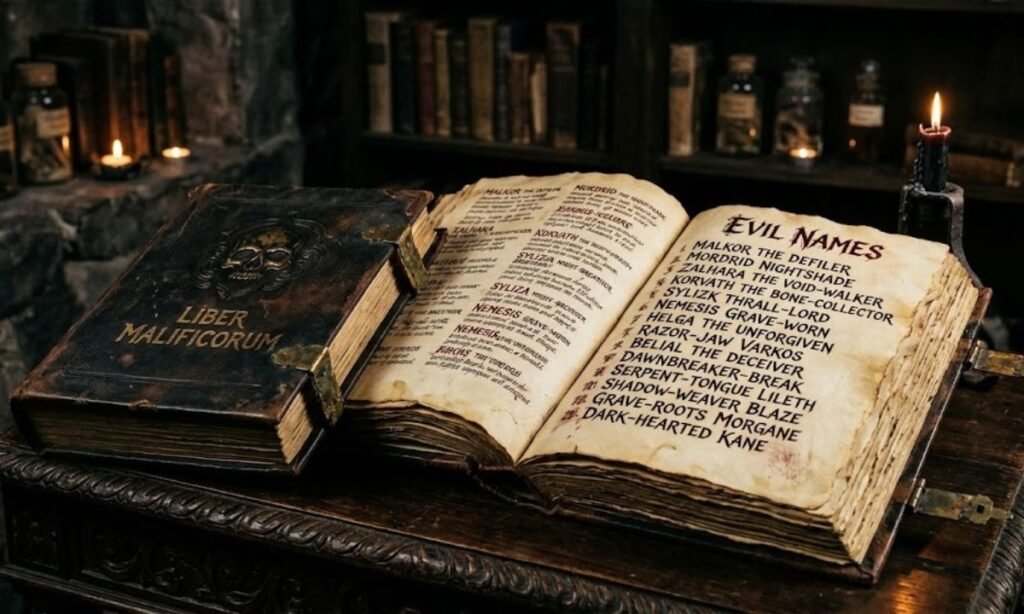
- Cain: Hebrew, often explained as “acquired” or “spear.” The first murderer in Genesis made this name a symbol of fratricide.
- Brutus: Latin for “heavy” or “dull.” Linked to the Roman who betrayed Caesar.
- Nero: from a Sabine word said to mean “strong” or “brave.” Now tied to tyranny.
- Caligula: Latin for “little boot,” a nickname from his childhood in a military camp.
- Vlad: Slavic, meaning “to rule.” Associated with Vlad the Impaler.
- Mallory: Old French for “unfortunate.”
- Draco: Latin for “dragon” or “serpent.” It also belongs to an Athenian lawgiver whose harsh laws gave us the word “draconian.”
- Bane: Old English for “slayer” or “ruin.”
- Ulric: Old English for “wolf ruler.”
- Garrick: Old English for “spear ruler.”
- Wolfgang: Germanic for “wolf path.”
- Lothar: Germanic for “famous army.”
- Lucrezia: Italian form of Lucretia, made infamous by the Borgia family, though historians dispute the poison legends.
- Messalina: the name of a Roman empress remembered for scandal.
- Agrippina: Roman, linked by Pliny to being born feet first. Also an empress known for ambition.
- Tiberius: from the river Tiber.
- Commodus: Latin for “proper” or “convenient,” ironic for the cruel emperor.
- Sulla: the family name of a Roman dictator known for proscriptions.
- Cesare: Italian form of Caesar, tied to Cesare Borgia.
- Attila: Gothic for “little father.”
- Dante: short for Durante, “enduring,” and forever tied to the Inferno.
- Ichabod: Hebrew for “no glory” or “the glory has departed.”
- Herod: Greek for “hero-like,” used for the king of the nativity story.
- Ahab: Hebrew for “father’s brother,” the wicked king of Israel.
- Judas: Hebrew for “praised,” now a byword for betrayal.
Evil Girl Names With Dark Meanings
- These names carry real roots in words for sorrow, bitterness, blackness, or death.
- Dolores: Spanish for “sorrows.”
- Amara: from Latin “amarus,” bitter.
- Marah: Hebrew for “bitter.”
- Mara: also “bitter,” and the name of a tempter figure in Buddhist tradition.
- Melanie: Greek for “dark.”
- Melaina: Greek for “black.”
- Kali: Sanskrit for “black” or “time.”
- Ciara: Irish for “dark.”
- Thana: from Greek “thanatos,” death.
- Nocturna: coined from Latin “nox,” night.
- Sable: the color black.
- Ebony: dark wood, deep black.
- Onyx: a black stone.
- Jet: a glossy black gemstone.
- Corvina: Latin, “raven-like.”
- Umbra: Latin for “shadow.”
- Tenebra: from Latin “tenebrae,” darkness.
- Moira: Greek for “fate” or “portion.”
- Nemesia: drawn from “nemesis,” retribution.
- Cassandra: the cursed prophet whom nobody believed.
- Ananke: Greek for “necessity.”
- Morbella: coined from Latin “morbus,” disease.
- Maledicta: Latin for “cursed.”
- Dira: Latin for “dire.”
- Furia: Latin for “fury.”
- Vendetta: Italian for “revenge.”
- Lacrima: Latin for “tear.”
- Nigella: Latin for “little black.”
- Noire: French for “black.”
- Tristana: a feminine form of Tristan, tied to sorrow.
More Best Evil Names — Quick Reference
- Malrik, Vexara, Grimald, Corvus, Draxus
- Morvain, Zalgrath, Nocthar, Hollowen, Ashmael
- Cindrel, Dravenna, Kragen, Sablen, Thornel
- Obsidia, Blightra, Vyrion, Maldrake, Ruinar
- Wrathen, Dreadmar, Blackmere, Gloomwyn, Cruxis
- Hexen, Nihilar, Sorrowind, Venomar, Skarmora
Evil Biblical Names for Girls
- Biblical names show how real history shaped our idea of wicked women. A few come from tradition rather than scripture, and I note those below.
- Jezebel: Phoenician princess and queen of Israel, linked to idol worship and the killing of prophets.
- Athaliah: queen of Judah who seized the throne by killing her own royal relatives.
- Delilah: the woman who betrayed Samson to the Philistines.
- Herodias: wife of Herod Antipas, who pushed for John the Baptist’s death.
- Salome: named by the historian Josephus as Herodias’s daughter, tied to the dance and the Baptist’s execution.
- Sapphira: struck dead in Acts for lying about money given to the church.
- Zeresh: wife of Haman, who urged him to build the gallows in Esther.
- Cozbi: the Midianite woman killed in Numbers during a scandal at Peor.
- Noadiah: a false prophetess opposing Nehemiah.
- Lilith: not named as a person in Genesis, but rabbinic tradition made her Adam’s first wife, and Isaiah 34:14 uses a related term for a night creature.
- Zuleika: the name tradition gives to Potiphar’s wife, who falsely accused Joseph.
Evil Male Names
- These 25 names have a Gothic, aristocratic feel that suits cold, controlled villains.
- Viktor
- Dmitri
- Anton
- Leopold
- Casimir
- Fabian
- Gregor
- Hugo
- Jasper
- Julian
- Kristoff
- Lazarus
- Marek
- Nikolai
- Otto
- Pascal
- Quentin
- Rupert
- Soren
- Tobias
- Ulysses
- Valentin
- Wendell
- Xavier
- Zane
Powerful evil names male
- These names borrow from Norse and warrior traditions, so they suit conquerors and warlords.
- Maximus
- Augustus
- Ragnar
- Thorgrim
- Harald
- Ivar
- Sweyn
- Eirik
- Gunnar
- Hakon
- Magnar
- Orm
- Rurik
- Torvald
- Haldor
- Svend
- Zarek
- Kane
- Dagan
- Rhodric
- Brannoch
- Cadogan
- Dunmore
- Gorvald
- Hroth
Evil Male Names with Meanings
- Kieran: from Irish “ciarán,” little dark one.
- Duncan: Gaelic, usually “dark warrior” or “brown warrior.”
- Dougal: Gaelic for “dark stranger.”
- Doyle: Irish, from “dubh gall,” dark stranger.
- Duff: from “dubh,” black or dark.
- Donovan: Irish, linked to a “dark” or “brown” ancestor.
- Dorian: tied to the Dorian people of Greece, but Oscar Wilde made it sound sinister.
- Damon: Greek, often explained as “to tame.”
- Vaughn: Welsh for “small.”
- Morris: from the Latin word for “Moorish” or dark-skinned.
- Maurice: the same root, and the older form.
- Blake: Old English that can mean either “dark” or “pale,” a rare name with two opposite readings.
- Bale: Old English “bealu,” meaning evil or woe.
- Grim: Old Norse and Old English for “mask” or “fierce,” and a name Odin used.
- Slade: Old English for “valley.”
- Cade: Middle English for “round” or “lump.”
- Thorne: Old English for “thorn.”
- Mal: Latin “malus,” bad.
- Torin: Irish “chief,” or from Old Norse “Thor.”
- Dunstan: Old English, often explained as “hill stone.”
Evil names for Cats
- Cats suit evil names because they stare, stalk, and knock things off tables with total confidence.
- Salem
- Voodoo
- Hex
- Gremlin
- Poltergeist
- Grimalkin: an old English word for a witch’s cat.
- Wraith
- Phantom
- Spook
- Menace
- Havoc
- Chaos
- Mayhem
- Scratch: from “Old Scratch,” a folk name for the devil.
- Gargoyle
- Fang
- Mischief
- Sabbath
- Cauldron
- Nightshade
More Evil Male Names — Quick Grid
- Alastair, Barnabas, Cedric, Edmund, Fergus
- Gideon, Horatio, Ignatius, Laszlo, Mordecai
- Obadiah, Peregrine, Reynard, Silvano, Tybalt
- Uriah, Vance, Wolfram, Yorick, Zebedee
- Abelard, Bartleby, Crispin, Ezra, Hieronymus
- Jericho, Konrad, Lorcan, Ludovic, Octavius
Evil Female Names
- Agatha
- Beatrix
- Griselda
- Hortensia
- Imelda
- Philomena
- Rowena
- Sybil
- Winifred
- Xanthe
- Ysolde
- Zenobia
- Ottilie
- Perdita
- Tabitha
- Vivienne
- Wilhelmina
- Araminta
- Belladonna
- Cressida
- Drusilla
- Evadne
- Fenella
- Gwendolyn
- Hepzibah
Evil Female Names with Meanings
- Lorna: invented for a Victorian novel, probably from “forlorn.”
- Kerrigan: Irish, linked to the “dark one.”
- Branwen: Welsh, “bran” (raven) plus “wen” (fair).
- Elvira: Spanish, with an uncertain origin.
- Brunhilde: Germanic for “armored battle.”
- Hilda: Germanic for “battle.”
- Gunhild: Norse for “war battle.”
- Sigrid: Norse, “victory” plus “beautiful.”
- Thora: from the god Thor.
- Rhiannon: Welsh, likely “great queen.”
- Isadora: Greek for “gift of Isis.”
- Zelda: possibly a short form of Griselda, “grey battle.”
- Ingrid: Norse, “Ing’s beauty.”
- Astrid: Norse for “divinely beautiful.”
- Ragnhild: Norse for “counsel battle.”
- Hildegard: Germanic for “battle enclosure.”
- Gertrude: Germanic for “spear strength.”
- Matilda: Germanic for “mighty in battle.”
- Waltraud: Germanic for “ruler strength.”
More Evil Female Names — Quick Grid
- Anathema, Dolorosa, Ebonwyn, Faustine, Gorgonia
- Ilvara, Karmine, Lucinda, Maldora, Nerezza
- Orsolya, Pestilia, Quillara, Sorrowen, Tormenta
- Venefica, Wraithwyn, Zaphira, Nightwyn, Ashenara
- Bloodwyn, Duskara, Emberlyn, Frostveil, Grimhild
- Hexana, Ivorwyn, Jadeveil, Kryssa, Morcessa
Names That Mean Evil Across Languages
- Many languages have a plain word for “evil” or “wicked” that sounds striking as a name.
- Malus: Latin for “bad.”
- Maleficus: Latin for “wrongdoing” or “harmful.”
- Nequam: Latin for “worthless” or “wicked.”
- Scelus: Latin for “crime.”
- Improbus: Latin for “wicked” or “shameless.”
- Pravus: Latin for “crooked” or “depraved.”
- Poneros: Greek for “wicked.”
- Kakos: Greek for “bad.”
- Mauvais: French for “bad.”
- Böse: German for “evil.”
- Malo: Spanish for “bad.”
- Malvagio: Italian for “wicked.”
- Mau: Portuguese for “bad.”
- Olc: Irish for “evil.”
- Drwg: Welsh for “bad.”
- Ond: Swedish for “evil.”
- Illr: Old Norse for “bad.”
- Yfel: Old English for “evil.”
- Paha: Finnish for “bad.”
- Kötü: Turkish for “bad.”
- Bura: Hindi for “bad.”
- Sharr: Arabic for “evil.”
- Zlo: Slavic for “evil.”
- Ra: Hebrew for “bad.”
- Dushta: Sanskrit for “wicked.”
Names That Mean Darkness and Shadow
- Layla: Arabic for “night.”
- Nox: Latin for “night.”
- Caligo: Latin for “darkness” or “mist.”
- Obscura: Latin for “dark.”
- Tenebris: Latin for “in the darkness.”
- Nocte: Latin for “night.”
- Skuggi: Old Norse for “shadow.”
- Myrkr: Old Norse for “dark.”
- Natt: Norse for “night.”
- Skia: Greek for “shadow.”
- Kage: Japanese for “shadow.”
- Yami: Japanese for “darkness.”
- Yoru: Japanese for “night.”
- Mrak: Slavic for “darkness.”
- Dorcha: Irish for “dark.”
- Tamas: Sanskrit for “darkness.”
- Andhera: Hindi for “darkness.”
- Shab: Persian for “night.”
- Choshech: Hebrew for “darkness.”
- Zalam: Arabic for “darkness.”
Names That Mean Destroyer
- Apollyon: Greek for “destroyer,” named in Revelation.
- Abaddon: Hebrew for “destruction.”
- Shiva: called “the Destroyer” in the Hindu trinity, though the role is about transformation, so use it with care.
- Rudra: the Vedic storm god, often explained as “the howler.”
- Nirrti: Vedic goddess of ruin and decay.
- Olethros: Greek for “ruin” or “destruction.”
- Vastator: Latin for “devastator.”
- Eversor: Latin for “overthrower.”
- Exitium: Latin for “destruction.”
- Pernicia: from Latin “pernicies,” ruin.
- Ruina: Latin for “collapse.”
- Clades: Latin for “disaster.”
- Vandal: after the tribe that sacked Rome.
- Obliterus: coined from “obliterate.”
- Ravager: an English word that works as a title-name.
Names That Mean Evil Spirit
- Kakodaimon: Greek for an evil spirit.
- Rakshasa: Sanskrit for a demon of Indian tradition.
- Ifrit: a powerful jinn in Arabic tradition.
- Marid: another class of jinn.
- Ghoul: from Arabic “ghul,” a grave-robbing spirit.
- Strigoi: Romanian for a restless dead or vampire spirit.
- Vetala: Sanskrit for a spirit that inhabits corpses.
- Pishacha: Sanskrit for a flesh-eating spirit.
- Lemures: Roman restless spirits of the dead.
- Eidolon: Greek for a phantom.
- Dybbuk: Jewish folklore for a wandering soul that possesses the living.
- Draugr: Norse undead.
- Revenant: French for “one who returns.”
- Phasma: Greek for “apparition.”
- Larva: Latin for a malicious ghost.
Evil Names from Mythology
- Medusa
- Eris
- Nemesis
- Hecate
- Circe
- Medea
- Clytemnestra
- Tisiphone
- Megaera
- Alecto
- Lamia
- Typhon
- Echidna
- Charybdis
- Scylla
- Erebus
- Nyx
- Loki
- Hel
- Fenrir
- Surtr
- Angrboda
- Apophis
- Set
- Tiamat
Male Evil Names for Villains and Dark Lords
- These coined names are built for thrones of bone, black towers, and armies of the undead.
- Xarthos
- Ulgrim
- Vorlag
- Kaldris
- Thalgor
- Gorvash
- Draegar
- Morbane
- Vexmar
- Zorathen
- Eldrazar
- Kronvar
- Baelthor
- Azmodrek
- Brakkus
- Cyrath
- Dargoth
- Haldrek
- Ishtavar
- Jorvund
- Korthak
- Lazgrim
- Mortrek
- Nythros
- Pyrrhax
Evil Names from Literature’s Greatest Villains
- Iago: the scheming ensign in Shakespeare’s Othello.
- Macbeth: the Scottish general who murders his way to a crown.
- Lady Macbeth: the ambition behind that murder.
- Claudius: the usurping uncle in Hamlet.
- Fagin: Dickens’s criminal who trains children to steal.
- Bill Sikes: Dickens’s brutal burglar.
- Uriah Heep: Dickens’s falsely humble schemer.
- Moriarty: Sherlock Holmes’s great enemy.
- Dracula: Bram Stoker’s vampire count.
- Mr. Hyde: the dark side in Stevenson’s novella.
- Mrs. Danvers: the chilling housekeeper in Rebecca.
- Sauron: Tolkien’s dark lord.
- Voldemort: the dark wizard of the Harry Potter books.
- Cruella de Vil: the fur-obsessed villain of Dodie Smith’s novel.
- Captain Hook: Peter Pan’s pirate enemy.
- Count Olaf: the greedy guardian in A Series of Unfortunate Events.
- Grendel: the monster of Beowulf.
- Mephistopheles: the devil figure in the Faust legend.
- Hannibal Lecter: Thomas Harris’s cultured killer.
- Nurse Ratched: the controlling nurse of One Flew Over the Cuckoo’s Nest.
Why These Names Work
- Most are tied to a strong sound, like the hiss in Iago or the thud in Macbeth.
- Several use contrast, such as the gentle title “Nurse” paired with a harsh surname.
- Dickens loved speaking names. Heep, Fagin, and Sikes each sound like their owners.
- Some fuse a real word with menace. “Moriarty” echoes “mors,” Latin for death, in the ear, though that link is only suggestive.
- Repetition builds the myth. Readers hear these names in adaptations and parodies, which makes them stick.
- A lesson for writers: give the reader one clear feeling per name, and avoid overloading it.
Evil Names from Mythology and Religion
- These names come from world traditions, so I suggest reading a short summary of each before using it in fiction.
- Ahriman: the destructive spirit in Zoroastrian tradition.
- Azhi Dahaka: a three-headed monster of Persian myth.
- Ravana: the ten-headed demon king of the Ramayana.
- Kamsa: the tyrant uncle of Krishna.
- Hiranyakashipu: the demon king defeated by Vishnu in his man-lion form.
- Duryodhana: the lead rival in the Mahabharata, meaning “hard to defeat.”
- Shakuni: the cunning gambler of the same epic.
- Vritra: the serpent of drought in Vedic hymns.
- Rangda: the demon queen of Balinese tradition.
- Jormungandr: the world serpent of Norse myth.
- Baba Yaga: the Slavic witch with a hut on chicken legs.
- Koschei: the Slavic sorcerer who cannot die.
- Chernobog: the “black god” attributed to Slavic belief, though the evidence is thin.
- Lamashtu: Mesopotamian demoness who threatened mothers and infants.
- Ereshkigal: Mesopotamian queen of the underworld.
- Tezcatlipoca: Aztec god of night, sorcery, and conflict.
- Mictlantecuhtli: Aztec lord of the dead.
- Ammit: Egyptian devourer of the unworthy dead.
- Chiyou: ancient Chinese war figure and rival to the Yellow Emperor.
Evil Names Inspired by Darkness and Shadow
- Umbriel: a gloomy sprite from an Alexander Pope poem.
- Eclipsa
- Gloamwyn
- Duskmantle
- Shadowmere
- Penumbra: the partial shadow at an eclipse’s edge.
- Nightveil
- Obscurion
- Murkwen
- Stygia: from the Styx, river of the underworld.
- Crepuscula: from Latin for twilight.
- Noctivar
- Dimmerel
- Shaderoth
- Blackveil
Evil Names Inspired by Death and Decay
- Necros: from Greek “nekros,” corpse.
- Mortis: Latin for “of death.”
- Morbus: Latin for “disease.”
- Letha: from Greek “lethe,” forgetfulness.
- Cadaveria
- Rotwyn
- Graveth
- Decaris
- Sepulchra
- Bonewyn
- Rigor
- Pallor
- Wither
- Ossuary
- Carrion
Scary Villain Names, Evil Titles & Dark Fantasy Ideas
- A title can make a villain feel bigger than a name alone, and it helps readers remember them.
- The Hollow King
- The Bone Regent
- Lady of Ash
- The Pale Sovereign
- Queen of Thorns
- The Crimson Warden
- Lord of Rot
- Duke Gravemont
- The Whispering Prince
- Mother Nightshade
- The Iron Tyrant
- The Veiled Oracle
- The Crowned Raven
- Archon of Ruin
- The Plague Magister
- The Silent Baron
- The Black Cantor
- Warden of Ashes
- The Gilded Executioner
- The Mirror Witch
Evil Last Names and Evil Family Names
- Surnames suggest bloodlines, which helps when a villain belongs to a cursed or powerful house.
- Blackwood
- Ravenscroft
- Grimsdale
- Hollowell
- Crowhurst
- Ashworth
- Graves
- Mortlake
- Draycott
- Blackthorn
- Wraxall
- Dreadmoor
- Malvern
- Corbett
- Gallowglass
- Hexford
- Duskmore
- Voss
- Hargrave
- Sablewood
Evil Villain Names by Archetype
- Villains work best when the name matches how they hurt people. These four groups sort names by that approach.
- Pick the archetype first, then the name, and the choice becomes much easier.
The Cold Manipulator (Evil Through Intelligence)
- Severin
- Lucius
- Aurelian
- Isidore
- Cyprian
- Evander
- Calista
- Lysandra
The Wrathful Destroyer (Evil Through Rage)
- Thraxus
- Gorgrim
- Rognar
- Brakka
- Kragnar
- Ulgara
- Tharok
- Grimhorn
The Tragic Fallen (Evil Through Loss)
- Elarion
- Caelum
- Ilyana
- Valerian
- Auriel
- Rhaelin
- Isaura
- Everard
The Noble Seeming (Evil Hidden in Beauty)
- Verity
- Clemency
- Constance
- Felicity
- Honora
- Prudence
- Temperance
- Angelique
Gothic Evil Names
- Emeric
- Adelaide
- Barrington
- Desdemona
- Eleazar
- Florian
- Godwin
- Hesper
- Isambard
- Jocasta
- Leopoldine
- Obsidian
- Rosamund
- Sepulveda
- Theodora
- Ulrika
- Valmont
- Xanthippe
- Zacharias
- Lazarine
Evil Fantasy Names
- Zhaeron
- Vaelith
- Nargoth
- Illyrion
- Throkmar
- Xylara
- Ghaldur
- Ysmyra
- Tharnok
- Velkoran
- Orothil
- Neferia
- Kaelmoor
- Sylvaris
- Draelyn
- Morielle
- Ulthane
- Vhorash
- Zyphera
- Rhakmir
More Evil Fantasy Names — Quick Grid
- Aeloth, Bryndor, Cthara, Dolmaris, Evanor
- Fhaelin, Garuun, Hylaeth, Jhoran, Kolvaris
- Lhurak, Mythrin, Nhaldor, Orvael, Pherain
- Qorvath, Raenok, Sethrak, Tzaral, Urdane
- Vyshka, Wyrmael, Xorvash, Yzmeth, Zaldrin
Evil Demon Names
- These come from medieval and early modern demonology, not from modern fiction. Treat them as cultural history.
- Asmodeus
- Beelzebub
- Belial
- Mammon
- Leviathan
- Lucifer
- Azazel
- Moloch
- Belphegor
- Astaroth
- Paimon
- Pazuzu
- Samael
- Baphomet
- Malphas
- Furfur
- Vassago
- Marbas
- Orobas
- Zagan
Evil Witch and Sorcerer Names
- Morgause
- Nimue
- Gothel
- Mordegar
- Hexwyn
- Wyrdwyn
- Malkiel
- Vorsana
- Eldrick
- Zorvana
- Thessaly
- Grimoira
- Hexcrow
- Runevane
- Sorcellia
Evil Dark Lord Names
- Kazrath
- Moragh
- Xandrek
- Malvane
- Zargoth
- Volthar
- Thanatar
- Orgulon
- Sarkoth
- Kharnage
- Vaelor
- Grask
- Tyranox
- Hadrakh
- Nekhor
Evil Dragon Names
- Nidhoggr: the root-gnawing dragon of Norse myth.
- Fafnir: the dragon slain by Sigurd.
- Ladon: the hundred-headed guardian of the golden apples.
- Pyrothax
- Scorchfang
- Ignarion
- Vyrmax
- Cinderwing
- Emberclaw
- Dreadscale
- Sulphura
- Ashfang
- Blightwyrm
- Obsidiax
- Magmaros
Evil Japanese Names
- Many of these are yokai or demon names from Japanese folklore, so research the tale before using them.
- Akuma: “devil” or “demon.”
- Shuten-doji: the legendary drinking-loving oni king.
- Tamamo-no-Mae: the nine-tailed fox who disguised herself as a courtesan.
- Orochi: the eight-headed serpent defeated by Susanoo.
- Ibaraki-doji: an oni connected to Shuten-doji’s band.
- Jorogumo: a spider yokai who lures men.
- Nurarihyon: a slippery yokai often called the “commander of yokai.”
- Gashadokuro: a giant skeleton formed from the unburied dead.
- Hannya: the demon mask of jealousy in Noh theatre.
- Magatsuhi: a spirit of calamity in Shinto tradition.
- Yomotsu-shikome: the hags of the underworld.
- Akuryo: “evil spirit.”
- Mononoke: a vengeful spirit.
- Ayakashi: a strange or haunting presence on the sea or in the night.
- Rasetsu: the Japanese form of the rakshasa.
Evil God Names
- Hades: Greek ruler of the underworld.
- Thanatos: Greek personification of death.
- Moros: Greek spirit of doom.
- Phobos: Greek personification of fear.
- Deimos: Greek personification of terror.
- Enyo: Greek goddess of war and destruction.
- Keres: Greek spirits of violent death.
- Nergal: Mesopotamian god of plague and war.
- Mot: Canaanite god of death.
- Yaldabaoth: the flawed creator figure in Gnostic texts.
- Dis Pater: Roman lord of the underworld.
- Orcus: Roman punisher of oath-breakers.
- Mors: Roman death.
- Erlik: Turkic lord of the underworld.
- Ah Puch: Maya death god.
Evil Cat Names
- These are punny or dramatic names for a cat with a proud, villainous streak.
- Lucifur
- Count Catula
- Purrdition
- Catastrophe
- Hellion
- Venom
- Widow
- Jinx
- Reaper
- Tyrant
- Overlord
- Dreadpaw
- Nightstalker
- Shiv
- Dagger
Sinister and Creepy Names
- Creepy names often feel like everyday titles with something wrong underneath.
- Mr. Gaunt
- Sister Lull
- Mother Hush
- Uncle Rattle
- Miss Pallor
- Doctor Hollow
- The Tallow Man
- Bellringer Finch
- Nurse Marrow
- Mr. Nettle
- Madame Whisper
- Governess Crane
- Mr. Scrimshaw
- Widow Thistle
- Old Man Cobb
- Sister Wick
- Mr. Pinch
- Aunt Grisly
- The Candlewick Child
- Mister Slumber
Evil Names for D&D and RPG Antagonists
- Game masters need names players can say quickly across the table, so I kept these easy to pronounce.
- Azrakul
- Thessalor
- Kyrgoth
- Vexmira
- Dravos
- Skellig
- Orveth
- Vanthrax
- Zarnos
- Nyxeth
- Ironveil
- Maxenroth
- Sorrowmane
- Hesk the Bonebinder
- Orrin the Cultmaster
Evil Villain Names for D&D by Creature Type
- Liches: Vazreth, Ilsmara, Corvanthus, Mordalen
- Vampires: Vesko, Isoldine, Radomir, Zdenka
- Orc warlords: Grakthul, Urzog, Mazgash, Dukrag
- Hags: Granny Wormroot, Mother Briarlock, Auntie Gloam, Black Annis (a hag from English folklore)
- Dark cultists: Zaelith, Velkynn, Nalfein, Dorvaine
Why Your Villain’s Evil Name Matters for Your Story
- A name is the first thing a reader learns about a character, so it sets expectations right away.
- A strong name can hint at backstory, culture, and power without a single line of explanation.
- Good names make dialogue easier, because characters can speak them with fear, anger, or mockery.
- Memorable names help readers recall the villain across a long series.
- A mismatch between name and personality can be used on purpose, but do it knowingly.
- Writing tip from practice: test a name by placing it in a threatening sentence. If it still works, keep it.
Can a Good Evil Name Make Your Character Iconic
- Yes, but a name alone cannot do the job. It must be paired with clear motives and strong scenes.
- Iconic villains often have names that are short, strange, and easy to say.
- Many have a quiet echo of meaning, which readers may feel without knowing why.
- A name can also be shortened into a nickname, which gives fans something to repeat.
- Avoid loading the name with too many apostrophes or silent letters, which can look silly.
- The best test is whether someone can say it aloud after reading it once.
How to Create Your Own Evil Name
- If you cannot find a perfect fit, build one. The five methods below work for any genre.
Method 1: Weaponize Phonosemantics
- Choose a mood first, such as brutal, smooth, or ancient.
- Pick sounds that match. Hard consonants suit brutes, while sibilants suit schemers.
- Example results: Kragnoth, Zukhar, Vrask.
Method 2: Find the Hidden Evil in Virtue Names
- A virtue name on a cruel character creates irony and unease.
- Ask what the name promises, then break that promise.
- Example results: Mercy, Amity, Benedict.
Method 3: Use Real Demonology
- Old grimoires such as the Ars Goetia list dozens of demon names.
- Use them as a starting point and adjust the spelling for your world.
- Example results: Andras, Focalor, Ose.
Method 4: Corrupt Something Beautiful
- Combine a lovely noun with a word for decay, thorn, or ruin.
- The contrast is the point.
- Example results: Lilyrot, Swanbane, Dawnrot.
Method 5: Mine Untranslated Language Darkness
- Some languages have words for feelings that English lacks, and the darker ones make rich names.
- Check each word with a native speaker or a trusted dictionary.
- Example results: Litost (a Czech word for a sudden agony at one’s own misery), Zal (a Polish word for grief or resentment), Weltschmerz (German for world-weariness).
How To Choose Evil Names
- Start with the role. Is this a schemer, a brute, a tempter, or a fallen hero?
- Match the culture. A name from a desert kingdom should not sound like a northern fortress.
- Say it out loud five times to check for tongue-twisters.
- Search it online to avoid accidental clashes with known characters or brands.
- Check the real meaning of any borrowed name, so you do not insult a culture or faith by mistake.
- For a real child or pet, think about how the name will feel at school, at work, and at the vet.
- Shortlist three names, sleep on them, and choose the one you still like in the morning.
Frequently Asked Questions
What is the most evil name in the world?
No single name is the most evil, because the feeling depends on culture and story. In the English-speaking world, names like Judas, Nero, and Lucifer carry the strongest negative history. Fiction adds others, such as Voldemort and Sauron.
What are some dark names that are not too extreme?
Names like Raven, Vesper, Silas, Selene, and Lenore feel moody without sounding cruel. They suit people who want a gothic feel without a villain label.
Can I use an evil name for a real baby?
You can, but think about meaning and reputation first. Choose a name whose root is neutral or beautiful, like Selene or Kieran, and avoid names tied to real crimes or hate figures.
How do I pick an evil name for a fantasy character?
Decide the character’s culture and nature, then build a name from sounds that fit. Use the methods in this guide to adjust spelling and test the name aloud.
Are demon names safe to use in stories?
Yes, for fiction. They come from old texts and are widely used in books and games. If you write for a religious audience, handle them with respect.
What makes a villain name memorable?
Clear sound, easy pronunciation, and a link to personality. A short name with one strong feeling is often more memorable than a long, complex one.
What is a good evil name for a cat?
Salem, Hex, Voodoo, Lucifur, and Count Catula are all popular. Pick one that fits your cat’s personality, such as a sleek black cat named Phantom.
Where can I find more dark name ideas?
Mythology, history books, old folklore collections, and etymology dictionaries are good sources. Read the meaning of any name before you use it.
Conclusion
Choosing an evil name is part craft and part instinct. You now have more than 850 options, from mythic demons and Roman emperors to original fantasy names and creepy everyday titles. Each one comes with a reason to love it, whether that is a meaning, a sound, or a story behind it.