


Have you ever heard a coyote yip at dusk and thought, that animal needs a name as clever as it is? You are not alone. Picking a name feels simple until you try. Everything sounds too plain, too silly, or already taken. The coyote is a wild canine from North America, and Native American stories call it a trickster. It is fast, brave, and very hard to fool. Your name should show that spirit.
This guide brings you 550+ fierce and clever coyote names for pets, story characters, mascots, and game heroes. You will find bold picks, cute picks, funny picks, and names from mythology, space, and nature. Some names are fierce, some are sweet, and a few are just plain silly. Each one comes with a simple meaning and a quick tip. Read slowly, say your favorites out loud, and keep the one that makes you smile when you call it.
Choosing the Perfect Coyote Name
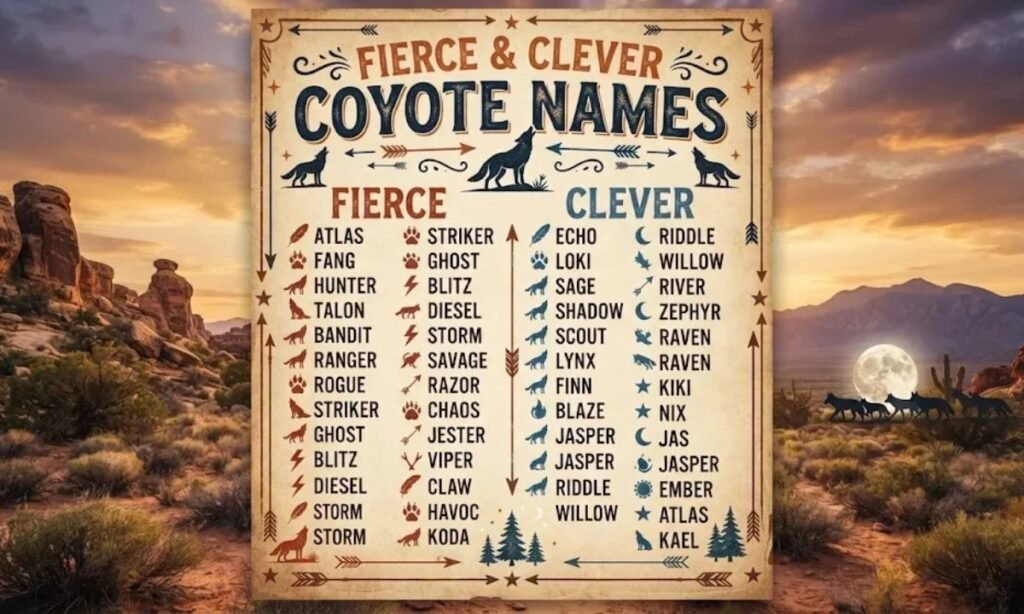
The perfect coyote name matches the animal’s temperament, looks, and story. Coyotes (Canis latrans) are clever wild canines from North America, so most people look for names that feel sharp, adaptable, and a little mischievous. Start with the feeling you want, and then pick the sound.
- Decide who you are naming. A dog with a wild look, a story character, a team mascot, and a game hero all need different names. A mascot can be loud and bold, while a bedtime character may sound soft.
- Learn a little about the animal first. Canis latrans means “barking dog” in Latin, and adults usually weigh 20 to 50 pounds, about the size of a medium dog. That size helps you decide whether a huge, heavy name or a tiny, cute one fits the picture in your head.
- Test names out loud. Say each one the way you would call it at a park or read it in a story. If it feels clumsy after five tries, drop it.
- Think short. One or two-syllable names are easy to call and easy for a dog to learn. A longer name works well for a book character, as long as readers can say it.
- Narrow down your list to 2 to 3 top contenders, then live with them for a day or two. Write each on a sticky note, use it in a sentence, and see which one still feels right.
- Check the meaning and origin before you commit. Names tied to Native American nations or indigenous mythology carry real cultural weight, so read about their source first. Many online lists copy one another and mix up origins, so double-check anything that matters to you.
- Be honest about wild coyotes. They are wild animals, and in many places keeping one as a pet is illegal or needs a permit. Wildlife agencies and sanctuaries advise against it. These names suit dogs, characters, mascots, and stories.
Best Coyote Names
The best coyote names are timeless picks that sound strong, roll off the tongue, and carry a good meaning. Many come from Greek legend, old English, or the wild itself. They suit a clever, independent canine that people respect at first sight.
- Atlas, Apollo and Athena come from Greek myth. Atlas held up the sky, Apollo ruled sun and music, and Athena stood for wisdom. Pick one for a thoughtful, steady coyote, but expect to meet other pets with the same name at the dog park.
- Phoenix and Jasper work well for a survivor. Phoenix is the bird that rises from ashes, and Jasper has Persian roots and means “treasurer.” Jasper is also a gemstone that is often red or brown, so it fits a warm-coated coyote.
- Maverick, Scout and Ghost match a loner. Maverick means an independent one who ignores the herd, Scout is one who watches, and Ghost suits a quiet, nocturnal animal that slips away at night.
- Winston, Felix and Oliver are friendly picks. Winston means “joy stone,” Felix is Latin for “lucky,” and Oliver points to the olive tree and to peace. A gentle companion will wear them well.
- Leo, Arlo, Dexter and Spirit are short and easy to shout across a field. Leo is Latin for “lion,” Arlo is often read as “fortified hill,” Dexter means “skillful,” and Spirit means a free soul.
Top Coyote Names
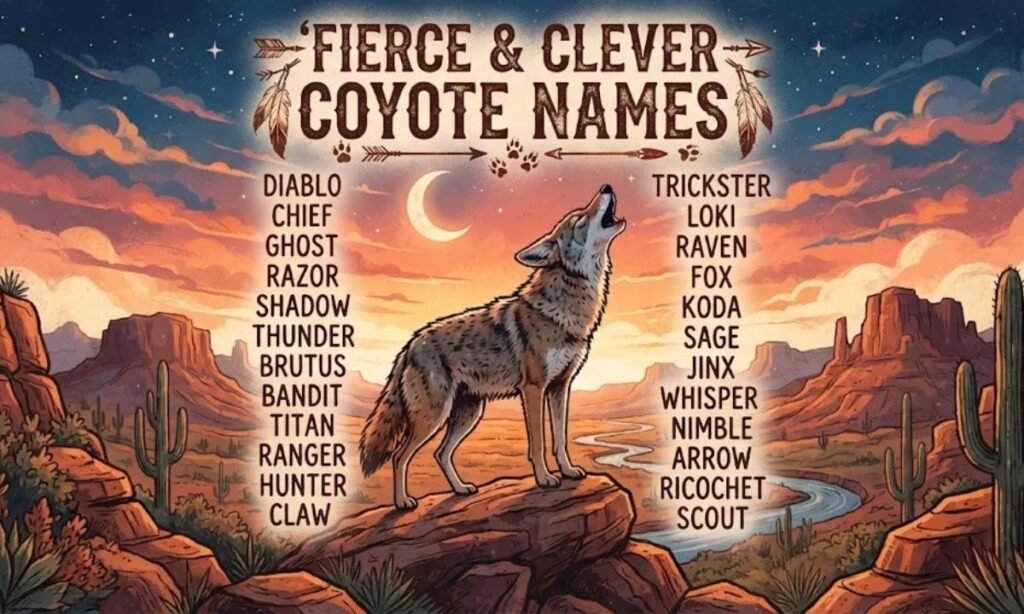
Top coyote names are the popular, trending picks that many dog owners, writers, and gamers choose right now. Most are short, friendly, and modern, which makes them easy to learn. They also look good on a name tag or a game profile.
- Kai, Milo and Max all have a bright, upbeat sound that carries well outdoors. Kai means “sea” in Hawaiian, Milo is often linked to “soldier,” and Max comes from the Latin for “greatest.”
- Bruno, Cooper and Bentley suit brown or tan coats. Bruno means “brown” in German, Cooper means “barrel maker,” and Bentley names a meadow with bent grass. Use them for a coyote with a warm, sandy look.
- Charlie, Rocky and Buddy feel like old friends. Charlie means “free man,” Rocky has a tough, stony ring, and Buddy says it plainly. They fit a loyal, easygoing dog.
- Tucker, Harley and Jax sound modern. Tucker was once a job name for a cloth worker, Harley means “hare meadow,” and Jax is a short form of Jackson. Hard consonants like these cut through noise.
- Ziggy, Coco and Ezra add a little personality. Ziggy feels quirky, Coco sounds sweet and is often tied to chocolate, and Ezra is Hebrew for “helper.” Together they cover both playful and calm.
Coyote Name Generator
A coyote name generator is a quick tool that turns your choices into fresh coyote name ideas. You pick a few details, press a button, and get dozens of suggestions in seconds. It is a good way to break a naming block.
- Follow the four steps. Select gender (male or female), select behavior (calm, playful, curious, bold, or gentle), select age (baby, adult, or old), then select tone (cute, funny, or elegant). Press generate name and read what comes up.
- Run it more than once. The first result is rarely the best one. Change a single setting at a time so you can see how each choice shapes the names.
- Treat results as ideas, not facts. A generator does not check meaning or origin. Look up any name you like before you use it for a book, a brand, or a tag.
- Try a do-it-yourself mix. Join a trait word with a nature word. Swift Sage, Copper Creek, Midnight Yip, Dusty Trail, and Silver Brook all work this way.
- Add a sound word for extra spark. Ember Howl, Storm Whisper, Juniper Dash, Thistle Moon, and Rusty Fang show how a howl or a whisper brings a name to life.
- Watch the spelling. Odd spellings cause trouble on vet forms, collars, and sign-up pages, so keep it simple if the name must be written often.
Male Coyote Names
Male coyote names sound rugged, loyal, and steady. They suit a pack leader, a solitary wanderer, or a protector who walks in front. Most have deep, strong sounds that feel at home on open desert plains.
- Hunter, Ranger, Tracker and Brock fit a coyote who lives by its nose. Brock is an old English word for badger. Coyotes and badgers have been seen hunting side by side, so it is a clever pick.
- Rex, Duke, Magnus and Axel sound noble. Rex is Latin for “king,” Duke means a noble leader, Magnus is Latin for “great,” and Axel is a Scandinavian name linked to “father of peace.”
- Tank, Gus, Hank and Otis feel sturdy and friendly. Tank suggests a tough build, Gus is short for Gustav or Augustus, Hank is a pet form of Henry, and Otis comes from an old German word for “wealthy.”
- Finn, Cody, Knox and Gage are crisp and short. Finn is Irish for “fair,” Cody is an Irish name linked to “helpful,” Knox means “round hill,” and Gage is French for “pledge.”
- Ace, Chase, Ryder and Boomer have an active, outdoorsy ring. Ace is a top card, Chase means to hunt, Ryder means “horseman,” and Boomer suits a loud one, since coyote yips and howls can be heard far across the night.
Female Coyote Names
Female coyote names mix grace with sharp survival instincts. Think of a swift huntress, a caring mother, or a clever escape artist. The best ones sound soft but still carry strength.
- Stella, Roxy, Maya and Juno shine like stars. Stella is Latin for “star,” Roxy is linked to a Persian word for “dawn,” Maya is Sanskrit for “illusion,” and Juno was the Roman queen of the gods.
- Bella, Mila, Ellie and Fiona are warm, pretty picks. Bella is Italian for “beautiful,” Mila is Slavic for “gracious,” Ellie is tied to the Greek word for “bright,” and Fiona is Gaelic for “fair.”
- Sadie, Zoey, Piper and Tess feel cheerful. Sadie is a Hebrew name for “princess,” Zoey is Greek for “life,” Piper means “pipe player,” and Tess is often tied to the word “harvester.”
- Ruby, Hazel, Ivy and Rosie borrow from gems and plants. Ruby is a deep red stone, Hazel is a nut tree, Ivy is a climbing plant, and Rosie points to the rose. They fit a coyote with an earthy coat.
- Lola, Vixen, Blair and Harper have extra attitude. Lola is a pet form of Dolores, which means “sorrows,” though most people hear it as cheerful. Vixen means a female fox, Blair is Scottish for “field,” and Harper means “harp player.”
Unisex Coyote Names
Unisex coyote names are gender-neutral options that focus on personality instead of labels. They are handy when you adopt a pup and do not know its sex yet, or when you write a character who could be anyone. Many draw on nature or old family names.
- Sage, River and Rowan are earthy. Sage is Latin for “wise” and also a desert plant, River means flowing water, and Rowan is Gaelic for “little red one,” named for a tree with red berries.
- Quinn, Riley and Casey all have Irish roots. They are linked to “counsel,” “courageous,” and “watchful,” so they work for a brave, alert coyote.
- Taylor, Jordan and Morgan feel classic and calm. Taylor means “tailor,” Jordan is linked to “flowing down,” and Morgan is Welsh, often explained as “sea circle.”
- Dakota, Skyler and Reese sound modern. Dakota comes from a Native American word often explained as “friend” or “ally,” Skyler is Dutch for “scholar,” and Reese is Welsh for “ardent.”
- Avery, Cameron and Blake round out the group. Avery points to “elf ruler,” Cameron is Scottish Gaelic and often explained as “crooked nose,” and Blake can mean either “dark” or “pale,” which is handy for a patchy coat.
Baby Coyote Names
Baby coyote names fit tiny pups full of curiosity and energy. Real coyote pups are born in a den, usually in spring, in litters that often hold around five or six. They are born blind and open their eyes in about ten days, so soft, small names match that stage well.
- Pip, Pebble and Sprout are tiny things from nature. A pip is a seed, a pebble is a small stone, and a sprout is new growth.
- Bean, Nibble and Fuzzy work for a cuddly, wriggly pup. Bean is small and sweet, Nibble means a small bite, and Fuzzy points to soft first fur.
- Scamp, Dash and Twig suit a pup that never sits still. Scamp is a mischievous one, Dash is a quick move, and Twig is a skinny little branch.
- Tiny, Smidge and Squirt are all about size. Smidge means a very small amount, and Squirt fits the smallest of the litter.
- Pipsqueak, Fern and Tot finish the group. Pipsqueak is a playful word for something very small, Fern is a soft green plant, and Tot means a little child. Remember that pups grow fast, so pick a name that still fits an adult.
Twin Coyote Names
Twin coyote names are matching pairs, complementary names, or rhyming names for siblings and a dynamic duo. The best pairs sound good together but still stand alone. Pick names that start with different letters, so each coyote answers to its own call.
- Romulus and Remus are the twin brothers from Roman legend, said to have been raised by a she-wolf. Castor and Pollux are twin brothers from Greek and Roman myth, linked to the Gemini stars.
- Yin and Yang come from Chinese thought, where opposite forces balance each other. Sun and Moon pair day with night, perfect for one calm coyote and one lively one.
- Thunder and Lightning arrive together, so they suit a loud, fast pair. Alpha and Omega are the first and last letters of the Greek alphabet. Wolf researcher L. David Mech has explained that wild packs are mostly families, not ranked “alphas,” so use this pair for fun and not as science.
- Salt and Pepper fit one light coat and one dark coat. Dusk and Dawn are a smart fit because coyotes are often most active at those two times.
- Ash and Ember sound like a fire and what it leaves behind, nice for a grey coyote and a rusty one. Zig and Zag rhyme and suit two playful runners.
- Frost and Snow suit a winter pair with thick coats. Pine and Cedar are two evergreen trees, a good match for a pair that lives near forests.
Classic Coyote Names
Classic coyote names nod to the animal’s best-known traits: cunning, mischief, and a sly grin. They have been used in stories for years, so they feel familiar right away. Think of the old campfire trickster tales.
- Trickster, Wiley and Sly point straight to the coyote’s cleverness. Wiley is a spelling of “wily,” which means clever in a sneaky way.
- Rascal, Bandit and Rogue suit a rebellious pup that steals socks and shoes. They sound playful, not mean.
- Mischief, Foxy and Crafty have a light touch. Foxy nods to the fox, a cousin in the canine family, and Crafty means skilled at tricks.
- Scoundrel, Vagabond and Prowler feel older, like characters from a fairy tale. Vagabond suits a wanderer, and Prowler suits a night hunter.
Unique and Exotic Coyote Names
Unique and exotic coyote names stand out from the pack. They borrow from far-off languages, wild weather, gemstones, and old myths. Rare names get attention, but check that people can say and spell them before you commit.
- Zephyr, Sirocco and Vortex are wind names. Zephyr is the west wind in Greek, Sirocco is a hot wind that blows from the Sahara toward southern Europe, and Vortex means a swirl.
- Vesper, Nyx and Umbra are night names. Vesper is Latin for “evening,” Nyx was the Greek goddess of night, and Umbra is Latin for “shadow.” They suit a nocturnal coyote.
- Kismet, Rune and Calypso carry mystery. Kismet means fate, Rune is an old Norse word for a secret mark, and Calypso means “she who conceals” in Greek.
- Obsidian, Zircon and Xanthe shine like gems. Obsidian is black volcanic glass, zircon is a sparkling stone, and Xanthe is Greek for “golden.”
- Kestrel and Lynx borrow from other wild hunters. A kestrel is a small falcon, and a lynx is a wild cat that shares parts of the coyote’s range.
Strong and Fierce Coyote Names
Strong and fierce coyote names show power, courage, and a commanding presence. They fit a coyote with an iron will, a long stride, and a stare that makes others step aside. Gods, giants, and sharp animal parts are popular sources.
- Zeus, Thor and Ares come from Greek and Norse myth. Zeus ruled the sky, Thor was the thunder god, and Ares was the god of war.
- Titan, Hercules and Brutus are about size and muscle. A titan is a giant, Hercules is the Roman name for the Greek hero Heracles, and Brutus is Latin for “heavy.”
- Diesel, Viper and Raptor feel quick and dangerous. Diesel suggests a strong engine, a viper strikes fast, and a raptor is a bird of prey.
- Fang, Talon and Saber are sharp-edged words. They fit a fighter, but a very fierce name can make strangers nervous around a big dog, so think about where you will use it.
- Mako, Blitz and Fury hit hard. Mako is the Maori word for “shark,” Blitz is German for “lightning,” and Fury means wild anger.
Bold Coyote Names
Bold coyote names belong to the fearless and the heroic. Survival in the wild takes courage, and these names say so loudly. They work for a protector, a defender, or the one who always steps up first.
- Valor, Courage and Hero are all about bravery. They are simple, so everyone understands them right away.
- Champion, Victor and Warrior sound like winners. Victor is Latin for “conqueror,” and a warrior is a fighter who never backs down.
- Striker, Guardian and Sentinel suit a coyote who stands watch. A striker hits fast, while guardian and sentinel both mean someone who protects others.
- Defender, Shield and Vanguard finish the set. Vanguard is the front line of an army, which makes it a great name for the coyote who leads the way.
Cool and Edgy Coyote Names
Cool and edgy coyote names sound sharp, rebellious and a little dangerous. They suit a sleek canine with golden eyes that walks its own path, whether it lives on a desert ridge or in a comic book. Short names with hard sounds work best.
- Blade, Steel and Hawk feel quick and shiny. A blade has a cutting edge, steel is forged metal, and a hawk is a sharp-eyed hunter. Real coyotes usually have amber or yellow eyes, so a name like Hawk fits that stare.
- Colt, Jett and Blaze are good for a dark coat with a bright flash. Colt is a young horse, Jett comes from the black gemstone jet, and Blaze means a bright fire.
- Cobra, Venom and Vandal sound dangerous, but say them out loud first. Calling “Venom!” across a busy park can earn you strange looks, so think about where you will use the name.
- Knight, Rebel and Reaper are best for story characters. Knight is a noble fighter, Rebel is someone who resists the rules, and Reaper is a dark, moody name that works better in a fantasy tale than on a family dog.
- Try this test: say the name in a soft, sweet voice. If it still sounds good, it is a keeper. Real coyotes also carry their tails low when they run, which gives them a sleek, ghost-like look that edgy names try to copy.
Royal Coyote Names
Royal coyote names borrow from kings, queens, emperors and old nobility. They fit a coyote that holds its head high and looks like it owns the whole prairie. These names sound grand, so they work best on a calm, proud animal or a regal character.
- Caesar, Kaiser and Czar are all family. The German word kaiser and the Slavic word czar both come from the name Caesar, so they all mean “emperor.” Only one of the three is needed for your coyote.
- Cleopatra and Pharaoh come from ancient Egypt. Cleopatra ruled from about 51 to 30 BC, and pharaoh was the title of Egypt’s kings and queens. Use them for a smart, golden-coated coyote.
- Baron, Marquis and Viscount are old ranks of nobility in Europe. Marquis and Viscount are French in origin, and they sound fancy without being common on dog tags.
- Duchess, Empress and Sultan give you strong names for a female or a bold male. Sultan is Arabic for “authority,” and empress comes from Latin.
- Regent, Monarch, Majesty and Crown are great for storybooks. A regent rules while a young heir grows up, which makes it a neat choice for a coyote who guards a litter. A very long title can be hard to shout, so keep a short nickname handy.
Cute and Adorable Coyote Names
Cute and adorable coyote names sound like treats, toys and tiny flowers. They match a soft face, big ears and a wagging tail. These names work well for a puppy that looks like a small coyote, or for a gentle storybook character.
- Honey, Cookie and Muffin come from the kitchen. They are warm and sweet, and they tend to make people smile the moment they hear them.
- Peanut, Button and Nugget are all about being small. They are good for a little pup with a big personality.
- Pumpkin, Peaches and Maple feel cozy, like autumn. Their warm orange and tan colors suit a coyote with a sandy coat.
- Mochi, Biscuit and Cupcake are fun for dessert lovers. Mochi is a soft Japanese rice cake, so it fits a chubby, squishy pup.
- Teddy, Poppy and Kiki are a gentle trio. Teddy means “little bear,” Poppy is a bright red flower, and Kiki is a playful sound that kids find easy to say. A short, cute name has one more perk: little kids can say it, which helps if children will help train the dog.
Sweet Coyote Names
Sweet coyote names focus on love, peace and a gentle heart. Wild coyotes often stay paired for several years, and both parents help feed the pups. That caring side is what these names celebrate.
- Sugar, Darling and Treasure are loving words. They suit a coyote that follows you everywhere and loves a belly rub.
- Angel and Cherub share a heavenly feeling. Cherub comes from the Hebrew word for a winged guardian, and it works nicely for a pup with big, soft eyes.
- Dove, Melody and Harmony bring in music and peace. A dove is a symbol of calm, and these names suit a quiet coyote that sings along when it hears a siren.
- Bliss, Serenity and Grace point to happy, calm feelings. Serenity is a good pick for a coyote who sleeps in sunny spots all afternoon.
- Faith is short and steady, and it works for an old, wise coyote or a loyal friend. If you want a sweet name that is not too sugary, pick one of the single-word virtues like Grace or Faith.
Fluffy Coyote Names
Fluffy coyote names celebrate thick, plush fur and cozy winter coats. A coyote has two layers of fur: a soft, dense underfur and longer, coarser guard hairs on top. In winter, that coat can make a coyote look much bigger than it really is.
- Cloud, Cotton and Puff are airy and light. They suit a pale, fuzzy coyote that looks like it might float away.
- Snowball and Fleece are great for a white or cream coat. Fleece comes from the soft wool of a sheep, so it fits a very curly or woolly coyote.
- Velvet and Cashmere are for a smooth, soft coat. Cashmere is a fine wool from the Kashmir goat, and the name sounds fancy without being stuffy.
- Woolly, Shaggy and Tuft describe messy fur in a fun way. A tuft is a little clump of hair, so use it for a coyote with a funny cowlick or fluffy ears.
- Pillow and Pompom sound huggable. Many coyotes have a bushy, black-tipped tail called a brush, so Pompom is a cute way to point at a round, fluffy tail.
Funny Coyote Names
Funny coyote names use puns, wordplay and silly words to match the clever, goofy side of this furry trickster. Coyotes are very talkative. Researchers have described around 11 different calls, and a small group can yip so loudly that they sound like a whole crowd.
- Taco, Noodles and Waffles are food names that make people laugh. They also work in a sad moment, because nobody can stay grumpy while yelling “Waffles!”
- Furball, Goof and Doofus fit a clumsy pup that trips over its own paws. They are all affectionate, not rude.
- Chuckles, Snicker and Hiccup come from small, funny sounds. They go well with a coyote that makes odd noises while it sleeps.
- Wobbles, Gremlin and Houdini point to naughty tricks. Houdini was a famous escape artist, so it fits a coyote that can open any gate.
- Bark Twain, Howliday and Sherlock Bones are puns for people who love words. Mark Twain described the coyote in his 1872 book Roughing It as “a living, breathing allegory of Want,” a funny, if harsh, picture of a hungry prairie wolf.
Playful and Quirky Coyote Names
Playful and quirky coyote names are bouncy, whimsical and full of energy. A coyote loves to chase, pounce and wrestle. In the wild, it can even leap high in the air to land on a mouse hiding in grass or snow.
- Bouncer, Hopper and Skipper are all about jumping. They fit an excited pup that bounces like a spring on its way to the food bowl.
- Frolic and Scamper are old words for happy play. Frolic comes from a Dutch word for “merry,” and scamper means to run in quick, light steps.
- Pounce, Twitch and Prance describe small moves. Use Pounce for a coyote that stalks your shoelaces, and Prance for one that walks like it is in a parade.
- Zippy, Peppy and Frisky give off a cheerful, speedy feeling. They are ideal for a young dog that has too much energy to nap.
- Trixie, Wiggles, Boing and Spry are odd and fun. Boing is a spring sound, and spry means lively and quick, which works even for an older coyote that still has a lot of bounce.
Crazy Coyote Names
Crazy coyote names are loud, wild and a little chaotic. They fit an unpredictable, eccentric coyote that breaks every rule. Coyotes are omnivores that eat rabbits, rodents, fruit and even insects, so a bit of chaos fits their story.
- Havoc, Chaos and Mayhem all describe a big mess. Chaos comes from an old Greek word for an empty, formless void, so it is a pretty big name for a pup that just chewed up a pillow.
- Riot, Frenzy and Tornado sound like fast, loud storms. They suit a coyote that zooms around the room at midnight.
- Loco and Wacky are friendly, laughing words. Loco means “crazy” in Spanish, so it works well for a coyote with a goofy streak.
- Zany and Kooky are playful, odd words. Zany comes from an Italian word for a clown servant in old comedy plays.
- Bonkers and Wildcard are for unpredictable personalities. A wildcard in a card game can be anything, which is just how this coyote acts. Before you choose, picture shouting the name at a vet’s office, since the wildest names can feel awkward in a quiet room.
Mystical and Magical Coyote Names
Mystical and magical coyote names fit a night-loving animal with glowing eyes and a haunting voice. Many people think coyotes howl at the moon, but they do not. They howl to talk to each other, and they are simply active at night, which is why the moon often shines on them.
- Merlin, Circe and Morgana are famous magic users from old legends. Merlin and Morgana come from the tales of King Arthur, and Circe was a Greek sorceress who turned men into animals.
- Oracle and Enigma carry a feeling of secrets. An oracle gives wise answers, and enigma comes from a Greek word for a riddle, so it suits a mysterious coyote.
- Wisp and Specter sound like drifting mist. A wisp is a thin trail of smoke or light, and a specter is a ghostly figure.
- Jinx and Mystic are short and spooky. Jinx comes from “jynx,” a bird that was once used in magic charms.
- Talisman, Elixir and Arcana sound like objects from a wizard’s shelf. A talisman is a lucky charm, an elixir is a magic drink, and arcana means secret knowledge. They work best for a fantasy character or a coyote with a dreamy, faraway look.
Native American Inspired Coyote Names
Native American inspired coyote names honor the animal’s role in many indigenous stories, where the coyote can be a trickster, a teacher and sometimes a helper in making the world. The word coyote itself comes from the Aztec language Nahuatl, where it was written coyōtl. These names are lovely, but they deserve care and respect.
- Koda, Mato and Makwa come from languages of the Plains and Great Lakes. Koda is often listed as a Lakota word for “friend,” Mato is Lakota for “bear,” and Makwa means “bear” in Ojibwe.
- Tokala and Hoka are Lakota words that fit a clever canine. Tokala is often explained as “kit fox,” a small, speedy relative of the coyote, and Hoka is a word for “badger.”
- Wanbli and Chayton also have Lakota roots. Wanbli is commonly translated as “eagle,” and Chayton is often explained as “falcon,” so they suit a coyote with sharp eyes.
- Ma’ii and Tala are worth a careful look. Ma’ii is the Navajo (Diné) word for “coyote,” and Tala is often listed as a word for “wolf” in several indigenous languages, though online lists disagree.
- Ahote, Wapi, Yuma, Aponi and Ahanu appear in many baby name lists with meanings like “restless one,” “lucky,” “son of a chief,” “butterfly” and “he laughs.” Be cautious, because these lists often mix nations and spellings, and I could not confirm every meaning.
- Before you pick, do three things: learn how the name is said, read about the nation it comes from, and ask someone from that community if you can. Some nations tell coyote stories only at certain times of year. For example, Diné coyote tales are traditionally shared in winter. Treat these names as a gift to honor, not as a costume.
Mythological Coyote Names
Mythological coyote names borrow from gods, tricksters and wild creatures in Greek, Roman, Norse, Egyptian, Aztec and African tales. They suit a clever, shape-shifting animal that seems to wink at the world. Pick one with a story you like.
- Hermes and Mercury are the Greek and Roman messenger gods. They ruled travel, trade and tricks, and the stories say baby Hermes stole cattle on his first day, which makes this pair a perfect match for a sly pup.
- Loki and Fenrir come from Norse myth. Loki is the trickster god, and Fenrir is his giant wolf son. Odin, the chief Norse god, kept two wolves named Geri and Freki at his side.
- Odin, Freya and Hera are rulers. Odin leads the Norse gods, Freya is a goddess of love, war and magic, and Hera is the Greek queen of the gods.
- Artemis and Hecate are Greek goddesses with wild sides. Artemis is the goddess of the hunt and wild animals, and Hecate guards crossroads and magic. Dogs were sacred to her, which makes her a cool choice for a dog-like coyote.
- Anubis and Xolotl belong to Egypt and the Aztec world. Anubis is shown with a jackal’s head, and Xolotl is a dog-headed Aztec god who guides souls. Both are linked to canines, so they fit a coyote well.
- Anansi, Eshu, Pan and Faunus are clever helpers and wild gods. Anansi is the spider trickster from West African Akan stories, Eshu is a Yoruba messenger at the crossroads, Pan is the Greek god of the wild (the word panic comes from his name), and Faunus is his Roman cousin who watches over fields and forests.
Coyote Names from Folklore and Legends
Coyote names from folklore and legends come from trickster tales told on many continents. A trickster is a clever character who bends rules, fools bigger animals and teaches a lesson by accident. These stories give a name some history, so it feels like more than a label.
- Kitsune and Tanuki are Japanese. Folktales say a kitsune, or fox spirit, can grow more tails as it ages, up to nine, and can turn into a person. The tanuki is a real raccoon dog, and in stories it is a jolly shapeshifter. Both suit a clever, sneaky coyote.
- Reynard is the sly fox hero of medieval European fables, which were told and retold from about the 12th century. Pick him for a coyote that talks its way out of every problem.
- Puck is a mischievous English woodland sprite. He is best known from Shakespeare’s play A Midsummer Night’s Dream, written in the 1590s. Puck is a fun, short name for a small, naughty pup.
- Inktomi and Nanabozho come from two different Native American traditions. Inktomi is a Lakota spider trickster, and Nanabozho is an Anishinaabe hero who plays tricks and teaches. Not every nation has a coyote trickster, so these show how many forms the same idea can take.
- Maui and Wukong are far-away heroes. Maui is a Polynesian demigod who, in the stories, slowed the sun to give people longer days. Wukong is the Monkey King from the Chinese novel Journey to the West, written in the 1500s.
- Amarok and Sedna come from Inuit stories. Amarok is a giant wolf that hunts alone, and Sedna is the goddess of the sea. Some of these figures are sacred to the people who tell the stories, so read about them before you borrow the name.
- Til is short for Till Eulenspiegel, a German jester who played pranks in tales printed around 1510. It is a rare pick that most people will not know.
- A word of caution: folk tales change from village to village. If you care about getting a story right, read more than one source before you tell it to others.
Coyote Names with Historical and Cultural Significance
Coyote names with historical and cultural significance honor real people, places and old traditions. The coyote has a long human story, from Aztec temples to the notebooks of explorers. A name tied to that past gives a character or a pet some extra weight.
- Neza is short for Nezahualcoyotl, a poet-king who ruled the city of Texcoco in the Aztec world, from 1431 to 1472. His name is Nahuatl and is often explained as “fasting coyote.” The long form is hard to say, so Neza makes a handy nickname.
- Coyotl and Huehue come from the same source. Coyotl is the Nahuatl word that later became “coyote” in English. Huehue comes from Huehuecoyotl, an Aztec trickster god of music, dance and mischief whose name means “old coyote.”
- Lewis and Clark are the two explorers who crossed the American West from 1804 to 1806. Their journals describe the coyote and call it a “prairie wolf.” In 1823, the naturalist Thomas Say gave the animal its science name, Canis latrans, which means “barking dog.”
- Galileo, Darwin and Magellan are thinkers and travelers. Galileo studied the stars, Darwin studied how living things change, and Magellan led the first trip that sailed around the world. They fit a curious coyote that is always looking around the next hill.
- Boudica, Nefertiti and Zenobia are famous queens. Boudica was a Celtic queen who led a revolt against Rome around 60 AD, Nefertiti was an Egyptian queen, and Zenobia ruled Palmyra in the 200s AD. These are strong picks for a female coyote.
- Hannibal and Amelia finish the group. Hannibal was a clever general from Carthage who crossed the Alps with war elephants, and Amelia calls to mind the pilot Amelia Earhart. Both stand for bravery and sharp planning.
- Keep it respectful: if a name belongs to a real culture, use it with care and try to learn what it means to the people who use it.
Coyote Names from Different Languages
Coyote names from different languages let you carry a meaning from far away. A single word from Swahili, Mongolian or Maori can say “brave” or “night” in a very short, catchy way. Most are easy to say, but check each pronunciation before you use it.
- Jasiri and Nyota are Swahili. Jasiri means “brave,” and Nyota means “star.” Jasiri is a good pick for a fearless coyote.
- Koa and Aroha come from the Pacific. Koa is Hawaiian for “bold” or “warrior,” and Aroha is Maori for “love.” Together they show both sides of a coyote’s nature.
- Kahu is a Maori word for a harrier hawk. It suits a coyote with sharp eyes that watches the field before it moves.
- Hoshi and Kaze are Japanese. Hoshi means “star,” and Kaze means “wind.” Both are short, soft and easy to call.
- Dorje and Tashi are Tibetan. Dorje is a thunderbolt, a strong symbol in Tibetan culture, and Tashi means good fortune.
- Layla, Surya and Lupus are old and poetic. Layla is Arabic for “night,” Surya is the Sanskrit word for the sun, and Lupus is Latin for “wolf.” A coyote is a close cousin of the wolf, so the last one makes a clever nod.
- Sombra and Conall have European roots. Sombra is Spanish for “shadow,” and Conall is a Gaelic name often explained as “strong wolf.”
- Temujin is the birth name of Genghis Khan, the Mongolian ruler. Its meaning is often given as “of iron,” though sources differ. It is rare, strong and a bit mysterious.
Coyote Names Based on Physical Traits
Coyote names based on physical traits describe what you can see: big ears, a bushy tail, a narrow snout or messy fur. An adult coyote usually stands about 21 to 24 inches at the shoulder and weighs between 20 and 50 pounds. Its look is a mix of lean, long and scruffy, so there is a lot to play with.
- Radar and Pointy are for big, upright ears. A coyote’s ears are tall and triangular, and they turn like tiny dishes to catch a mouse’s squeak under the snow.
- Bushy and Whisker point to fur. The coyote’s tail is full and bushy, and it is usually held low when the animal runs. Whisker fits a pup with a bold face.
- Snout and Goldeye celebrate the face. A coyote’s muzzle is thin and pointed, and its eyes are often amber or yellow. Goldeye is a fun, glowing name for that stare.
- Lanky, Gangly and Stretch describe long legs. These names fit a coyote that looks all legs, especially a teenage pup that has not grown into its paws.
- Stubby and Stocky are the opposite. They suit a short, round dog with a wide chest.
- Scruffy and Notch are about rough edges. Scruffy fits a messy coat, and Notch suits an animal with a small nick in its ear, a common mark of a rough life outdoors.
- A small tip: young coyote pups are often born with darker, browner fur that changes as they grow. If you name a pup for its looks, you may need to wait a few weeks.
Coyote Names Based on Personality
Coyote names based on personality focus on temperament, mood and behavior. Coyotes are known for being curious and quick to learn, and a good personality name should make people smile when they see the animal act that way. You can only pick one fairly after you have watched the animal for a while.
- Brave, Daring and Gutsy are for a pup that walks right up to the vacuum cleaner. They fit a fearless coyote that never hides behind its pack.
- Cunning, Savvy and Cheeky suit the classic clever type. A savvy coyote figures out how to open a gate, and a cheeky one steals a sock and then looks proud about it.
- Feisty, Plucky and Jolly sit in the lively middle. They fit a coyote with lots of spirit that loves to play and rarely sulks.
- Shy, Mellow and Stoic are for a calmer animal. A stoic coyote stays quiet and steady even when the world is noisy, and a shy one needs time to trust people.
- Wise and Loyal are best for older companions. They fit a coyote that guards the family and learns every habit of the home.
- A fair warning: puppies change. A wild little troublemaker may become the calmest dog on the street by age two, so wait a few weeks before you pick a name that locks in a trait.
Coyote Names Reflecting Speed and Agility
Coyote names reflecting speed and agility match the animal’s quick feet and quick mind. Coyotes can run at about 40 miles per hour in short bursts, swim well and slip through tight spaces. These names are short, sharp and full of motion.
- Bolt, Racer and Sprint are about pure speed. They work well for a coyote that wins every race to the food bowl.
- Turbo, Zoom and Rapid feel like machines. They are loud and fun, and kids love yelling them across a field.
- Streak, Dart and Gust are lighter. A streak is a quick line of light, a dart is a small arrow, and a gust is a sudden push of wind.
- Swift and Whip are sharp one-syllable names. They are good picks if you need a name you can call in a hurry.
- Leap and Flicker are about agile moves. Leap fits a coyote that can jump a fence, and Flicker fits one that disappears and appears in a blink.
- Quicksilver and Pronto end the list with style. Quicksilver is an old word for the liquid metal mercury, and pronto is Spanish for “quickly.”
- A safety note: a fast name does not make a safe dog. If your coyote-like dog can run that quickly, use a fenced yard or a long leash.
Coyote Names Reflecting Colors and Patterns
Coyote names reflecting colors and patterns describe the coat. A typical coyote wears a blend of gray and tan, with reddish tones behind the ears, a pale belly and a black-tipped tail. Coat color varies by place: coyotes in deserts are often paler, and those in mountains are often darker.
- Copper, Amber and Auburn are warm reds and golds. They suit a coyote with a rusty glow in the sun.
- Sienna, Russet and Tawny are earthy browns. Sienna is a clay-like pigment, russet is a reddish brown, and tawny is a soft yellow-brown.
- Dusty, Rusty and Goldie are friendly, casual names. They sound like a dog you would meet at a ranch.
- Smoky, Slate and Charcoal fit a gray coat. Slate is a dark gray rock, and charcoal is burnt wood, so both feel strong.
- Pewter and Silver are for a pale, shiny gray. Silver is a great choice for an older coyote with a frosty muzzle.
- Onyx and Ebony are for a very dark coat. All-black coyotes are rare, and scientists have traced a black-coat gene in some wild canines to past mixing with domestic dogs.
- Ivory fits a very light cream coat that looks like a winter prairie.
- Freckles, Speckle and Dapple cover patterns. They fit a coat with spots, flecks or a mottled look, and they sound cheerful.
Coyote Names with Strong Meanings
Coyote names with strong meanings carry a clear idea inside them, like courage, honor or a wolf’s power. They are good for a leader, a guardian or a hero in a story. The best ones have a short word that is easy to say and a meaning you can explain in one line.
- Arrow and Quest are simple and bold. An arrow flies straight to its goal, and a quest is a long journey with a purpose.
- Glory, Honor and Legacy are about being remembered. They fit a coyote who will be the star of a family or a book series.
- Resolve, Triumph and Liberty sound like a stand taken. Liberty suits an independent coyote that hates being tied down.
- Zenith means the highest point, from an Arabic phrase about the path above your head. It is perfect for a coyote that always climbs to the top of the hill.
- Echo comes from Greek myth. Echo was a nymph who could only repeat the last words she heard, which is a lovely match for a coyote that answers every howl.
- Gideon and Alaric are old names. Gideon is a Hebrew name often explained as “mighty warrior,” and Alaric is a Germanic name that means “ruler of all.”
- Ulric and Leander are rare but good. Ulric is often explained as “wolf power,” and Leander comes from Greek words that mean “lion man.”
- Quick advice: do not choose a meaning that clashes with the coyote’s mood. A very serious name can sound funny on a goofy, tail-chasing pup.
Nature-Inspired Coyote Names
Nature-inspired coyote names draw from trees, plants, weather and water. Coyotes live outdoors, so these earthy names feel natural. They also make good picks if you want something gentle and strong at the same time.
- Birch, Oak and Aspen are tree names. Oak is a symbol of strength, birch has pale, papery bark, and aspen leaves shimmer in the wind. Evergreens like cedar and pine are also popular, but they appear in other lists.
- Juniper, Thistle and Bramble are tough plants. Coyotes eat berries and other fruit as well as meat, so these have a real link to what a wild coyote might nibble in a thicket.
- Willow, Clover and Moss are softer. Willow bends in a storm without breaking, clover is a lucky plant, and moss is a cozy green carpet.
- Brook, Creek and Rain are water names. A brook is a small stream, a creek is a little bigger, and rain is a gentle, shining shower. Pair them with an earthy sage or river name for a perfect set.
- Storm, Gale and Mist are weather names. They suit a coyote with a moody side, and they sound great when called into the wind.
- Flint, Clay and Timber are rugged and grounded. Flint is a hard stone once used to start fires, clay is soft earth, and timber is wood from trees.
- A simple rule: pick a nature name that fits the animal’s coat or mood. Mist for a gray coyote and Clay for a tan coyote will always feel right.
Coyote Names Reflecting Habitat
Coyote names reflecting habitat come from the land where these animals live. Coyotes roam from Alaska to Central America, and they are found in every U.S. state except Hawaii. They live in deserts, prairies, forests and mountains, and more and more of them now live in cities.
- Canyon, Mesa and Butte come from the American Southwest. A canyon is a deep valley with steep sides, and a mesa is a flat-topped hill. A butte is a smaller steep hill with a flat top.
- Arroyo and Dune are dry-land words. Arroyo is a Spanish word for a stream bed that is dry most of the year, and a dune is a hill of sand.
- Prairie, Meadow and Savannah are open grasslands. These wide-open spaces are classic coyote country, where the animals hunt mice, rabbits and ground squirrels.
- Plateau, Ridge and Summit are high places. Coyotes often use ridges to look for danger and to call to each other at dusk.
- Bluff, Gulch and Hollow are small hidden spots. A bluff is a steep cliff, a gulch is a narrow ravine, and a hollow is a small valley.
- Valley and Chaparral finish the set. Valley is a classic nature name, and chaparral is a thick scrub of shrubs found in places like California.
- Did you know? Researchers have tracked urban coyotes around Chicago since about 2000, and they found that most city coyotes avoid people and hunt at night. A name like Alley or Skyline can be a clever twist for a city-living character.
Coyote Names from Geography
Coyote names from geography use real places, from desert towns to far-off mountains. They are a good fit because coyotes now live from Alaska down toward Panama, and they spread east through the 1900s as wolves were cleared out. A place name can also be a quiet tribute to a spot you love.
- Sedona, Tucson and Mojave come from the American Southwest. Sedona is known for red rock, Tucson sits in the Sonoran Desert, and the Mojave is a huge dry basin. They suit a coyote with a sandy or rusty coat.
- Denver, Cheyenne and Laredo are Western towns. Cheyenne is also the name of a Native American nation, so read about its meaning before you use it for a pet.
- Yukon, Tahoe and Montana sound cold, clear and wild. The Yukon is a far northern region, Tahoe is a deep mountain lake, and Montana comes from a Spanish word for “mountain.”
- Everest, Sierra and Sahara are geographical landmarks you can say in one breath. Everest stands for the tallest peak on Earth, Sierra means “saw” in Spanish and names a jagged mountain range, and Sahara is the largest hot desert.
- Cairo is a short city name that works in either a male or female role. It is the capital of Egypt, so it pairs well with ancient names like Pharaoh.
- Think about it first: a place name is easier to love if you have a story with it. Pick the town where you met your dog, or the trail where you first heard a howl.
Coyote Names from Astronomy and Space
Coyote names from astronomy and space borrow from stars, comets and constellations. They fit a night-loving animal, and they sound bright and a little dreamy. These celestial elements also make a neat theme for a litter or a pair.
- Luna and Aurora are lovely under moonlight. Luna is Latin for “moon,” and Aurora was the Roman goddess of dawn, which is also the name for the northern lights.
- Orion, Lyra and Cassiopeia are constellations. Orion is the Greek hunter, Lyra is the harp, and Cassiopeia is a queen who shines in a W shape. Orion is great for a hunter type, and Lyra fits a coyote that sings at night.
- Sirius and Vega are real stars. Sirius is the brightest star in our night sky, and people call it the Dog Star because it sits in the constellation of the Greater Dog. Vega is the main star of Lyra.
- Comet and Meteor work for fast runners. The word comet comes from a Greek word for “long-haired,” so it is a clever pick for a coyote with a big, bushy tail.
- Nova, Nebula and Galaxy are dreamy. A nova is a star that flares up suddenly, a nebula is a glowing cloud of dust and gas, and our galaxy holds hundreds of billions of stars.
- Pulsar, Quasar and Draco are for a nerdy, bold feel. A pulsar blinks like a lighthouse, a quasar is a very bright center of a faraway galaxy, and Draco means “dragon.”
- Cosmo comes from a Greek word that means “order” and gives you a short, friendly space name.
Literary and Pop Culture Coyote Names
Literary and pop culture coyote names come from old books and famous characters. I kept to stories whose copyright has ended, so your name stays free of brand trouble. Public domain rules differ by country, so a quick check is smart if you plan to use a name for a business.
- Buck is the dog hero of Jack London’s novel The Call of the Wild, published in 1903. He leaves a warm home and joins a wild pack. That makes Buck a perfect fit for a coyote.
- Huck and Sawyer come from Mark Twain’s books about boys on the Mississippi River. They fit a pup that runs away to explore and comes home muddy.
- Watson is the loyal friend of the detective Sherlock Holmes in Arthur Conan Doyle’s stories. Use it for a sidekick coyote with a good nose.
- Ahab and Ishmael come from Moby-Dick, a novel from 1851. Ahab is the captain obsessed with a whale, and Ishmael is the storyteller. Ahab is intense, so it suits a very focused coyote.
- Gulliver and Heathcliff are from older classics. Gulliver is the traveler in Jonathan Swift’s tale from 1726, and Heathcliff is the stormy hero of the novel Wuthering Heights.
- Hamlet and Odysseus are two heroes from the stage and the epic poem. Hamlet is a thinker who can’t decide, and Odysseus is the clever Greek hero who tricked his enemies with a wooden horse. The second one is a trickster at heart, just like a coyote.
- A fair warning: I left out modern movie and cartoon characters on purpose. Their names are often trademarked, and a pet’s name is fine, but a book or channel name can cause trouble.
Names Based on Famous Coyotes
Names based on famous coyotes honor real animals and well-loved trickster figures. This list is short because I only included names I could trace to a real story or event. Each one gives your coyote a proud namesake.
- Hobo was a coyote who wandered into New York’s Central Park in 2006. He dodged capture for days, drew crowds, and was finally caught and sent to a wildlife rehabilitation center. His story showed how far a city coyote can roam.
- Sinav is a name from the Ute and Southern Paiute peoples, often listed as a Coyote and Wolf creator figure. Spellings and tales differ from nation to nation, so treat it with care.
- Italapas is often listed as a name for Coyote in Chinookan stories of the Pacific Northwest. Sources vary here as well, so check a trusted book before you tell the story.
- Old Man is the English form of a title that several Plains nations use in their stories for a powerful, funny Coyote who helps shape the world.
- Song Dog is not a person’s name, but a nickname that many people use for the coyote itself, because of its wild chorus at dusk. It is a lovely choice for a coyote that loves to howl.
Wild West Coyote Names
Wild West coyote names bring up dusty trails, old ranches and big skies. A themed group like this is fun when you have two or three animals, because the names work together. Historians put the classic Wild West years between about 1865 and the 1890s, and coyotes lived through all of them.
- Sheriff, Marshal and Deputy are law-keeper names. They fit a coyote that guards the yard and acts like it is in charge.
- Outlaw, Rustler and Drifter are for the roamers. A rustler steals cattle, and a drifter wanders with no home base. They sound bad, but with a pup they sound playful.
- Wrangler, Bronco and Lasso come from ranch life. A wrangler looks after horses, a bronco is a wild horse, and a lasso is a looped rope.
- Tumbleweed, Cactus and Spur are items from the desert and the stable. Tumbleweed is a dry plant that rolls across the plains, and spurs are small metal wheels on a rider’s boots.
- Sidewinder is a small desert rattlesnake that moves sideways across sand. It is a bold name for a quick, sneaky coyote.
- Know the history: ranchers fought coyotes hard in the late 1800s and early 1900s, using traps, guns and poison. Historian Dan Flores wrote in his book Coyote America that coyotes survived and even spread. That shows why the animal is a symbol of grit.
Fantasy Coyote Names
Fantasy coyote names have a magical, storybook feel. They match the animal’s mysterious side, and they work well for novels, tabletop games and role-play. This fantasy theme can be matched with a mystic pair, or you can give each character its own style.
- Aldric and Eldrin sound like kings and wizards. Aldric is a Germanic name often explained as “old ruler,” and Eldrin is a made-up name that feels elvish.
- Thorne and Kael are strong and short. Thorne points to a sharp, prickly bush, and Kael is often listed as a Celtic name, though the meaning is not settled.
- Faelan is a Gaelic name often explained as “little wolf.” It is a clever pick for a coyote because the wolf is its close cousin.
- Elowen and Morrigan are for a female coyote. Elowen is a Cornish word for “elm,” and Morrigan is a fierce Irish goddess of war and fate who can appear as a crow.
- Wyvern and Griffin are creatures. A wyvern is a two-legged dragon from old heraldry, and a griffin has the body of a lion and the head of an eagle.
- Fable, Seraph and Sylph are airy. A fable is a short story with a lesson, a seraph is a fiery angel in Hebrew tradition, and a sylph is a spirit of the air.
- Keep it legendary but readable. If readers can’t say the name on the first try, they will skip over it in your story.
Nicknames for Coyotes
Nicknames for coyotes are short nicknames that shrink a long name into something easy to shout. Nicknames also build recognition and bonding, because a pet hears the same friendly sound again and again. A good one rolls off the tongue in half a second.
- Yip, Howlie and Yote come from coyote sounds and slang. Yote is a nickname that many people in the West use for the animal itself.
- Coyo and Wolfie are easy shortcuts. Coyo cuts the word in half, and Wolfie makes a small wolf out of any coyote.
- Scrappy and Snoot are cheeky. Scrappy suits a small fighter, and Snoot is a loving word for a long nose.
- Spud and Socks work for goofy or white-footed pups. A spud is a potato, and socks are the white paws that some dogs wear.
- Dex, Mo and Zee are tiny one-syllable names. They are quick to call, and they work as a nickname for Dexter, Mojave or Zephyr.
- Bo, Roo, Kit and Nix finish the list. A kit is a young fox, and Nix is a Latin word for “snow.”
- Keep a nickname away from your commands. Trainers often warn that names like Kit or Bo can sound like “sit” or “no” when the dog is excited. Say it out loud with your usual training words before you commit.
A to Z Coyote Names
An A to Z coyote name list gives you one pick for every letter, which is a good way to browse. This alphabetical list is also useful when you need to name a whole litter or write a story with 26 chapters. Every name here is new to this article.
- A, B, C: Alder, Brindle, Cinder. Alder is a tree that likes wet ground, brindle is a coat with tiger-like streaks, and cinder is a small piece of burnt wood.
- D, E, F: Dingo, Eclipse, Falcon. A dingo is Australia’s wild dog, an eclipse is when one body passes in front of another in space, and a falcon is a fast bird of prey.
- G, H, I: Garnet, Halo, Indigo. Garnet is a deep red gemstone, a halo is a ring of light, and indigo is a deep blue-purple color.
- J, K, L: Jubilee, Kodiak, Lucky. Jubilee means a joyful celebration, Kodiak is a giant brown bear from Alaska, and Lucky is a friendly, easy pick.
- M, N, O: Mirage, Nomad, Ocelot. A mirage is a trick of the eye in a hot desert, a nomad moves from place to place, and an ocelot is a small spotted wild cat.
- P, Q, R: Paprika, Quartz, Rocket. Paprika is a red spice, quartz is a clear crystal, and Rocket is a loud, fast pick.
- S, T, U: Sable, Tundra, Ursa. Sable is a dark brown fur color, tundra is a cold, treeless plain, and Ursa is Latin for “bear.”
- V, W, X: Valiant, Whistle, Xanadu. Valiant means brave, a whistle calls a dog home, and Xanadu is the name of a legendary summer palace.
- Y, Z: Yarrow, Zion. Yarrow is a wildflower that grows in dry fields, and Zion is a Hebrew word for a hilltop or a place of peace.
Fun Facts About Coyote Names
Coyote names carry more history than most people expect. They link to indigenous mythology, old books and the simple habits of the animals themselves. The facts below add some heritage and symbolism to your list.
- There are two ways to say it. Many people say ky-OH-tee with three beats, and others say KY-oat with two. Both are common, so pick the one you hear in your own region.
- A smart dog can learn a lot of names. In a 2011 study, a border collie named Chaser learned the names of 1,022 toys. That is good news for anyone worried that a fancy name will confuse a dog.
- One US state has made the coyote its official animal. South Dakota did it in 1949.
- The coyote has a nickname. Many writers call it the “song dog,” a name that comes from its night-time chorus of yips and howls.
- Popular names change over time. Max, Bella and Luna have been near the top of US dog name charts for years, so a very common pick is hard to keep unique.
- Most name lists share the same sources. Botanical terms, weather elements, gemstones and metals show up again and again, which is why a name category like “nature” or “colors” can feel crowded.
- A name has three parts worth checking: the name meaning, the name origin and the name tone. A friendly sound with a dark meaning can still be a fun contrast, as long as you know it.
- Coyote symbolism is mixed. In many tales the animal is both wise and foolish, which makes funny, bold and sweet names all feel right.
Frequently Asked Questions About Coyote Names
What makes a good coyote name?
A good coyote name is easy to say, fits the animal’s look or mood, and still feels right after a week. Try the child test too: if a young kid can say it without help, most grown-ups, vets and dog-park friends can too.
Are coyote names appropriate for dogs?
Yes, coyote-style names work well for dogs that look wild, like Huskies, German Shepherds and wolf-dog mixes. They also suit any of our domestic dogs with a tan coat and big ears. Just remember that a real coyote and a pet dog are very different animals.
Can I change a coyote name later?
You can, and most dogs adjust quickly. Say the new name in a happy voice, give a treat each time, and mix it with the old one for a few days. Most animals learn a new sound within a few weeks, though older rescue dogs may take a bit longer.
Do short names work better?
Short names usually do, because the sound is clear even in wind or noise. Names with a crisp start and a bright ending, like Bo or Lucky, tend to stand out. Rhythm and flow matter too, so say the name with your last name or your usual command to see how it sounds.
Should I choose a bold or soft name?
Pick the one that matches the daily life you plan. A bold name suits a story hero, a team mascot or a guard-style dog. A soft name suits a family pet that will meet kids and strangers. If you cannot decide, try a bold first name and a soft nickname.
Are there gender-neutral options?
Yes, and many are very popular. Scout, Ember, Quill, Indigo and Sky all work for any coyote or dog. These choices are handy when you adopt a pup before you know its sex, or when your character never needs a label.
How can I make my coyote name unique?
Mix two small ideas, like a color and a place, or borrow a rare word from another language. A quick online search will show you if the name is common. A name that breaks a normal naming convention, like Copper Mesa, stands out and still feels natural, and it gives your coyote a unique identity.
How do I pick a name for a pair?
Call both names out loud at the same time. If you can still tell them apart, you have a winning pair. Names that share a vowel sound can confuse young dogs, so avoid pairs like Bo and Joe. Matching themes, such as Dusk and Dawn, still work well when the sounds differ.
Is it okay to use Native American names for a coyote?
It can be, if you do it with care. Check the meaning and the nation it comes from, and avoid words used for sacred things. If a name belongs to a living tradition, consider asking someone from that community. When in doubt, choose a name from another source.
What is the best name for a coyote character in a story?
Choose a name that fits the character’s job in the plot. A trickster needs a name with a wink, a villain needs a hard sound, and a young hero needs a name readers can say fast. Keep one-syllable and two-syllable names for main roles, and save long names for side characters.
Final Thoughts
Naming a coyote is part fun and part detective work. You have seen more than 550 fierce and clever ideas, from sweet picks like Honey and Grace to bold names like Titan and Valor, plus mythological, historical and fantasy choices.
The best moniker is the one that matches the personality, the look and the story you have in mind. Take your time, because a good name will be with your animal or character for years.